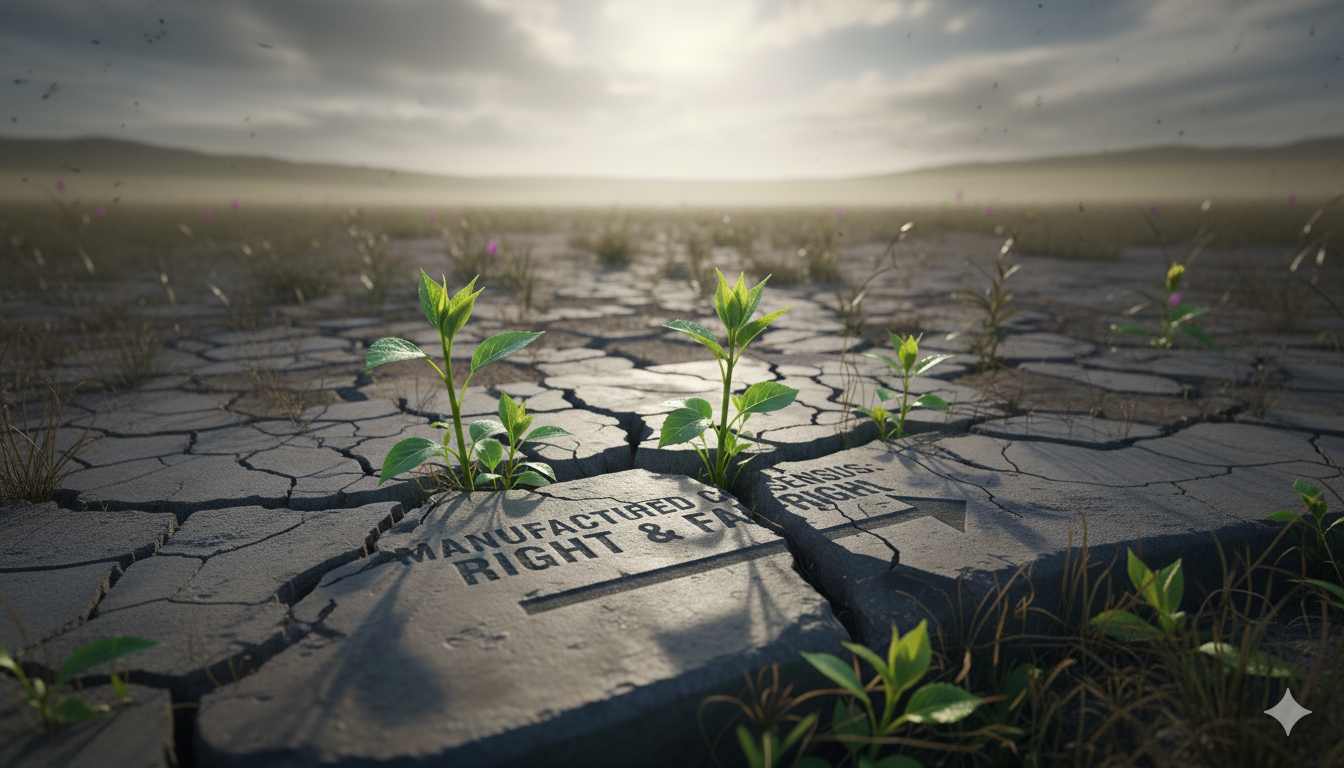
That grinding sense of exhaustion after every election in the UK has to change; we’ve had enough of two-party politics and first-past-the-post and the failed two-party system. Nobody wants to vote as a damage limitation exercise. Holding your nose, ticking a box for the least bad option, and hoping for the best, only to find the ‘best’ felt suspiciously like a slower, slightly more polite version of the same old austere managed decline. That feeling isn’t an accident. It’s the managed despair that keeps a broken two-party system on life support.
But what if that exhaustion is the signal that the game itself is changing? The 2024 election gave Labour a government, but it didn’t provide them with the courage to act on their mandate for real hope. With public support already fraying, a vacuum is opening up on the Left. And it is into this vacuum that the Green Party is stepping, powered not just by a sharp new strategy but by a tidal wave fuelled by hope. With membership surging past 124,000—making them the third-largest party and closing in on the Conservatives—this is no longer just a protest vote. It’s a movement gathering unstoppable force.
This movement is being channelled into a patient, four-phase plan to build a new politics from the ground up.
Phase One: Lay the Foundations in Our Communities. This is where the new energy is most visible. The strategy has already started not in Westminster, but in your town hall, and it’s being executed by a rapidly growing army of activists. The Greens’ 859 councillors are the tip of the spear, but the shaft is the thousands of new members turning up to canvass, deliver leaflets, and stand for election themselves. Every pothole fixed, every local renewable energy scheme approved becomes a proof of concept, building an infrastructure of trust that is powered by sheer people-power.
Phase Two: Inspire a National Conversation. With those local foundations secured by a legion of volunteers, the next step is to take the vision national. This means doubling down on a message of hope that resonates because it’s authentic. The membership surge isn’t happening in a vacuum; it’s a direct response to policies that offer a stark, positive choice: a wealth tax on billionaires to fund public services; bringing energy and rail back into public hands; rent controls to tackle the housing crisis. The strategy is to link these bold ideas to people’s daily lives, framing environmentalism not as a sacrifice, but as the essential toolkit for a fairer, more secure society—a message now amplified by over a hundred thousand voices.
Phase Three: Offer a Clear Choice in the Heartland. This is where the plan becomes truly focused, and where the new-found scale of the party becomes a powerful force for change. The aim is to methodically concentrate on over 100 constituencies where disillusionment with the old parties is highest. An ambition like that would have been a fantasy a few years ago. Now, funded by membership fees and powered by thousands of activists with the enthusiasm the major parties can only dream of, it becomes a credible alternative. This is how you create a green breakthrough: by having the boots on the ground to give voters a genuine choice, converting apathy into engagement and winning a formidable bloc of Green MPs.
Which brings us to Phase Four: Reshape the System for Good. This is the ultimate goal. The most realistic path to power isn’t winning 326 seats outright, but winning enough—perhaps 40, perhaps 60—to hold the balance of power. A strong bloc of Green MPs, backed by the largest and most engaged activist base in the country, would enter a hung parliament not merely as junior partners, but as architects of a new democracy with a non-negotiable mandate: electoral reform. With nearly 70% of the public supporting Proportional Representation, this is the moment you translate people-power into permanent, systemic change.
So, what does this mean for you, nursing that feeling of political burnout? It means recognising that the cage has no bars, and that you are not alone. The first step is internal: stop seeing politics as something done to you. But the most vital step is external. The energy fuelling this entire strategy isn’t coming from focus groups; it’s coming from people like you. When you join this movement, you aren’t just adding your name to a list. You are the fuel. You are the hands that help lay the foundations in Phase One, the voice that inspires the conversation in Phase Two, and the engine for the breakthrough that will make the old politics obsolete.
Like many writers in 2026, I use AI tools as part of my process, in this case Grok, Perplexity, Grammarly and Gemini, to help with research, brainstorming, exploration, and generating initial drafts and organising complex thoughts. However, this blog is not AI-generated content.
Every post is the result of my own research, lived experience, and extensive rewriting.
The final arguments, metaphors, and conclusions are mine alone. I disclose this because I believe the fight for human creativity begins with honesty about how we create.
 Quentin Budworth