Tag Archives: art

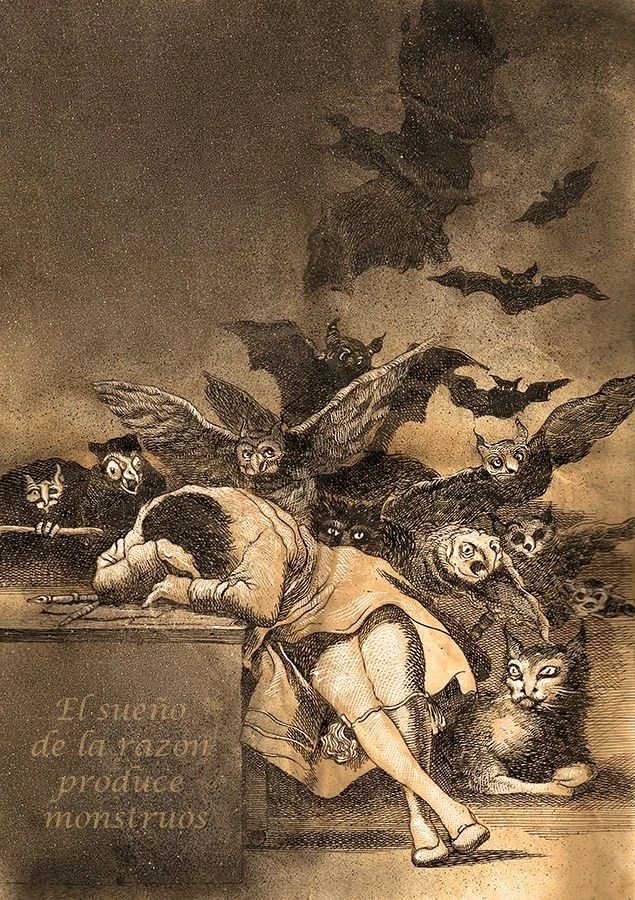
The Sleep of Reason: Why Goya’s Monsters are Winning in 2026

In Francisco Goya’s 1799 etching, The Sleep of Reason Produces Monsters, the artist is not merely napping. He has collapsed. His tools, the pens and paper of the Enlightenment, lie abandoned on the desk. Behind him, a swarm of owls and bats emerges from the blackness.

Goya’s Los Caprichos served as a warning to Spanish society, blinded by superstition and corruption. But today, the etching feels like a live-stream of the 2026 news cycle.

When reason sleeps, we don’t just dream of monsters. We build them.

The New Bestiary: Algorithms and Echoes

In the post-truth era, the “monsters” are digital. They are the algorithms that prioritise cortisol over comprehension.

According to the 2025 Digital News Report, we have reached a tipping point: 47% of the global population now identifies national politicians and “influencers” as the primary architects of disinformation. Reason hasn’t just faltered; it has been outsourced to partisan actors who benefit from its absence.

The Arendtian Nightmare

The political philosopher Hannah Arendt understood that the goal of total deception is not to make people believe a lie. It is intended to ensure that they can no longer distinguish between truth and falsehood.

In her 1967 essay Truth and Politics, Arendt warned that factual truth is “manoeuvred out of the world” by those in power. We see this today in the “defactualisation” of our economy. Despite rising consumer prices and growing unemployment, a barrage of “official” narratives in 2025 and 2026 has attempted to frame the economy as flawless. As Arendt predicted, when the public is subjected to constant, conflicting falsehoods, they don’t become informed—they become cynical and paralysed.

The Outrage Addiction

Why do we let the monsters in? Because they feel good.

Neuroscience tells us that outrage is a biological reward. A landmark study by Dominique de Quervain showed that the act of “punishing” a perceived villain lights up the dorsal striatum—the brain’s pleasure centre.

Social media is essentially a delivery system for this chemical hit. We are trapped in a cycle in which we conflate “online fury” with “social change.” This outrage functions as a smokescreen: while we argue over individual “villains” on our feeds, the structural monsters: inequality, surveillance, and capture – continue their work undisturbed.

The Architecture of the 1%

While the public is distracted by the digital swarm, wealth has been consolidated into a fortress. In 2026, the global wealth gap is no longer a gap; it is a chasm.

  • The Fortune: Billionaire wealth hit $18.3 trillion this year, an 81% increase since 2020.
  • The Control: The top 1% now own 37% of global assets, holding eighteen times the wealth of the bottom 50% combined.

This concentration of capital is the ultimate “monster.” It allows a tiny elite—who are 4,000 times more likely to hold political office than the average person—to dictate the boundaries of reality.

Cognitive Atrophy: The AI Trap

Our most vital tool for resistance, the human mind, is being blunted. A 2025 MIT study confirmed that heavy reliance on Large Language Models (LLMs) for critical thinking tasks correlates with weakened neural connectivity and a “doom loop” of cognitive dependency.

As the Brookings Institution warned in early 2026, we are witnessing a “cognitive atrophy.” If we offload our judgment to machines owned by the 1%, we lose the very faculty required to recognise the monsters in the first place.

Case Study: The Epstein Files and Systemic Silence

The release of 3 million pages of Epstein documents in January 2026 should have been a moment of total reckoning. With 300 “politically exposed persons” implicated—from British peers to European heads of state, the scale of the rot is undeniable.

Yet, the reaction has been a repeat of Goya’s etching. We focus on the “monsters” (the names in the files) while ignoring the “sleep” (the legal impunity and wealth-purchased silence) that enabled their existence. Epstein was not a glitch in the system; he was a feature of it.

Waking the Artist

Goya’s etching ends with a caption: “Imagination abandoned by reason produces impossible monsters; united with her, she is the mother of the arts and the source of their wonders.”

To wake up in 2026 requires more than “fact-checking.” It requires a reclamation of our tools:

  1. Cognitive Sovereignty: Limit the AI-driven “doom loop” and reclaim the capacity for independent analysis.
  2. Structural Sight: Stop chasing the “bats and owls” of individual outrage and look at the “desk”—the economic and political structures that house them.
  3. Institutional Integrity: Support the few remaining impartial bodies capable of holding power to account.

The monsters only vanish when the artist wakes up. It is time to pick up the tools.


Key References

Friction, Grit and Community

When I started out as an artist in the mid 80’s, I was young and had tremendous energy and enthusiasm for the arts. I had a steely determination to move from the analytical and critical headset that I had been taught at school and college, which I had excelled in, to the somewhat unknown and unknowable world of the arts as a performer, practitioner and facilitator.

I got hands-on training in street theatre at Bretton Hall from Charivari or The Salami Brothers, as they were known on the Festival circuit. A whole new world opened up to me. I learnt how to eat fire, breathe fire, juggle, walk on stilts, lie on a bed of nails, dance on broken glass, escape from chains, ropes, handcuffs, to emerge naked from a mail sack, mind read, present magic tricks in the round and hold an audience in my thrall with a silver tongue and attitude.

I learnt about storytelling and theatre from Taffy Thomas, who helped me weave a narrative that drew on and built on the skills I had already learnt. I managed to refine my skills, adding bagpipes and assorted musical instruments to my bag of performing tricks. All this took tremendous focus, painstaking attention, research, planning and a steely determination to succeed and make my work as a performer pay.

I was lucky to attend ‘Fool Time’ at Bristol Circus Space with Bim Mason, Franki Anderson, Guy Dartnell and John Lee, who taught me how to access my inner fool and be playful, with no fear, in front of an audience. The values of tenderness, humanity, humour, and the hilarity that a true understanding of human nature and its dark side can bring when challenged by circumstance, fate, or self-interest.

In the world of Street Theatre, I had a community of supportive friends, fellow artists and performers exploring the obscure and interesting: pyrotechnics, circus theatre, illusions, performance styles, music. We revelled in what we saw, shared and tried out. We met regularly at events and often visited each other during quiet times. We drew close and formed strong bonds in the face of challenging work conditions, common interests and experiences.

Which, in a roundabout way, brings me on to what I want to discuss: as artists, we need Friction, Grit and Community. They are the prerequisites to creating art that is human and has value.

Friction – art needs to be challenging and push at the edges of our experiences; it must present us with an activity in which we can think, make, or say something new. This isn’t easy and requires a lot of cognitive thought and effort. Which brings me on to

Grit – is energy, passion, focus, determination, resolve. Having the power, patience and intelligence to manifest an intention, bringing an idea into the real world for all to see and share.

Community – your audience, real people who engage with your work, give it sustained and focused attention. Audiences and artists who ask why, how, what, and when. Moving from passive to active engagement, becoming co-creators and fellow explorers.

This is only part of the picture; we have to add human Intelligence, independence, agency, humanity, calculated risk-taking, humour, a joy in life and living shared devils and angels.

AI cheats us out of all of this; it robs us by providing quick, easy answers that stop us from thinking and engaging with the ideas in our minds that need friction, grit and community to grow. It provides quick, easy results and content creation, but as artists, we need to be better than Silicon Valley’s quick fix. We need to be thinking longer and harder and articulating ideas that are pertinent, impertinent and disruptive to the billionaire class.

People think that AI is about computers getting smarter; it’s really about human agency getting cheaper, becoming biddable, and eventually becoming obsolete. Empowerment is the pitch, dependency is the business model. Stop trading your intuition for convenience. Every time you let an algorithm make your choice.

The system owns the path of least resistance; don’t walk it

Creating Art In The Age Of AI.

Here’s a series of actionable instructions to guide yourself as an artist in the AI era. Treat these as reminders to refocus on your intrinsic motivations and leverage your unique human strengths.

  1. Reflect on Your Core Motivation: Ask yourself why you’re making art in the first place. Write down your reasons – is it for personal expression, joy, or something else? If it’s primarily for external validation like social media likes, challenge that by creating one piece this week purely for yourself, without sharing it.
  2. Define Your Audience and Goals: Clarify who your art is for – yourself, a small circle, or the public? If public, define what success means to you (e.g., meaningful feedback vs. viral hits). Set a personal success metric, like “complete one project that sparks a conversation,” and track progress toward it monthly.
  3. Test Your Commitment: Imagine your entire creative setup is destroyed. Would you rebuild it? If yes, affirm your passion by dedicating time each day to creating without excuses. If not, explore other fulfilling activities to redirect your energy.
  4. Embrace Human Uniqueness: Remember that AI lacks intent and personal experience. Translate your abstract ideas or emotions into art deliberately – start by journaling one lived experience per session and turning it into a musical element or artwork.
  5. Avoid Genre Traps: If working in a structured genre, don’t just replicate patterns (which AI excels at). Intentionally break rules: Add an unexpected element and keep it human (e.g., fusing bal folk tunes with highland pipes and smallpipes) in your next piece to infuse originality from your mind.
  6. Prioritise Novelty Over Perfection: Chase ideas that intrigue you personally, not flawless output. Experiment with “weird gremlin thoughts” – set aside time weekly for accidental or random creations, then refine them into intentional work.
  7. Differentiate Hearing vs. Listening: Aim to make art that invites active engagement and conversation, not passive background filler. Review your recent work: Does it provoke introspection or critique? Revise one piece to emphasise emotional depth or uniqueness.
  8. Leverage Limitations as Strengths: Use your imperfections (e.g., skill gaps) as opportunities for innovation. Identify a weakness in your technique, then create a workaround in your next project – document how it adds a personal “U” (unique touch) to your art.
  9. Rise Above the AI Noise: In a sea of average AI content, make your work stand out by highlighting overlooked ideas. Observe something unnoticed in your daily life and “shove it in faces” through your art – produce one such piece this month.
  10. View AI as a Bar-Raiser: See AI as making this an exciting time for artists. Commit to creating something unique or weird regularly, knowing it gains value against infinite “slop.” Track how this mindset shifts your output over the next few projects.
  11. Final Affirmation: Remind yourself daily: Your art is a reflection of your human condition – feelings, experiences, and soul. AI is just output; yours is an expression of self. If doubt creeps in, revisit this list and create anyway.

Lesser-Known Truths About AI’s Inability to Question or Redefine Art. The statement “The machine doesn’t care. It knows exactly what art is. It has no reason and no ability to question what it could be” highlights a core philosophical critique of AI in creativity: it operates within predefined patterns without genuine intent, emotion, or the capacity for existential questioning. While mainstream narratives often celebrate AI as a democratising force in art (e.g., tools like DALL-E or Midjourney making creation more accessible), lesser-known truths challenge this by exposing AI’s fundamental limitations and their broader implications for humanity. These ideas are rarely shared publicly because they undermine the trillion-dollar AI industry, which thrives on hype, investment, and the promise of infinite productivity. Tech giants like Adobe and Meta promote AI as “creative” to sell subscriptions and data-training models, suppressing critiques that could slow adoption or invite regulation. Below, I outline key under-the-surface truths, supported by historical context, real-world examples, and explanations for their obscurity. 1. AI Art is a “Philosophical Zombie” – It Mimics Without Consciousness. AI can replicate artistic styles flawlessly but lacks inner experience or intent, resulting in hollow imitations rather than true expressions. This challenges the mainstream view that AI’s technical prowess equates to creativity, revealing it as mere pattern-matching.

  • Historical Context: This draws from René Descartes’ 1637 dictum “I think, therefore I am,” which tied existence to self-aware thought. More directly, it echoes John Searle’s 1980 “Chinese Room” argument: a person following rules to simulate understanding Chinese doesn’t truly comprehend it. Similarly, AI “understands” art only through data, not lived reality. Early algorithmic art in the 1960s (e.g., AARON by Harold Cohen) was celebrated, but philosophers like Searle warned it lacked soul, a critique buried as AI evolved.
  • Real-World Examples: In 2022, an AI-generated piece won the Colorado State Fair’s fine art competition, sparking backlash from artists who argued it lacked emotional depth. csferrie.medium.com Midjourney’s early versions struggled with human hands, symbolising its detachment from embodied experience—AI doesn’t “feel” anatomy like a human artist does. blog.jlipps.com
  • Why It Remains Hidden: Acknowledging this would deflate AI hype, as companies frame tools as “co-creators” to attract users. Investors and media focus on output quality to avoid philosophical debates that could lead to ethical restrictions, such as EU AI regulations that emphasise transparency.

2. AI Erodes Human Creative Capacity Through Atrophy and Over-Reliance. By handling the “hard” parts of creation, AI causes human skills to wither, turning art into a commodified process rather than a form of personal growth. This counters the mainstream claim that AI “lowers barriers” to creativity, showing it instead homogenises output and stifles innovation.

  • Historical Context: As with the 15th-century printing press, which displaced scribes but forced writers to innovate (e.g., leading to the rise of the novel), photography in the 1830s threatened painters until they embraced abstraction (e.g., Impressionism). Critics like Walter Benjamin in 1935 warned of art’s “aura” being lost in mechanical reproduction; today, AI amplifies this by automating not just reproduction but also ideation.
  • Real-World Examples: Artists using AI prompts often iterate endlessly to approximate their vision, losing direct agency—e.g., a digital artist settling for AI’s “approximation” rather than honing their skills. blog.jlipps.com In music, tools like Suno generate tracks, but users report diminished satisfaction from not “struggling” through composition, echoing how auto-tune reduced vocal training in pop. aokistudio.com
  • Why It Remains Hidden: The AI industry markets efficiency to creative professionals (e.g., Adobe’s Firefly), downplaying the long-term erosion of skills to maintain market growth. Public discourse prioritises short-term gains like “democratisation,” as admitting to atrophy could spark backlash from educators and unions concerned about job devaluation.

3. AI Exposes the Illusion of Human Originality, Revealing Most “Creativity” as Formulaic AI’s ability to produce “art” faster than humans uncovers that much human work is pattern-based remix, not true novelty—challenging the romanticised view of artists as innate geniuses and forcing a reevaluation of what “creative” means.

  • Historical Context: The Renaissance idealised the “divine” artist (e.g., Michelangelo), but 20th-century postmodernism (e.g., Warhol’s factory art) questioned originality. AI builds on this; Alan Turing’s 1950 “imitation game” test foreshadowed machines mimicking creativity without possessing it, but his warnings about over-attribution were overshadowed by computational optimism.
  • Real-World Examples: A Reddit discussion notes AI “revealing how little we ever had” by outperforming formulaic genres like lo-fi beats or stock photos, where humans were already “echoing” patterns. reddit.com In 2023, AI-generated books flooded Amazon, exposing how much publishing relies on tropes—authors admitted their “unique” stories were easily replicated. lateralaction.com
  • Why It Remains Hidden: This truth wounds egos in creative industries, where “originality” justifies high valuations (e.g., NFTs). Tech firms and media avoid it to prevent demotivation, as it could reduce user engagement with AI tools—why prompt if it highlights your own mediocrity?

4. AI Art Detaches Us from Authentic Human Connection and Imperfection AI’s frictionless perfection creates idealised content that erodes empathy and growth, as art traditionally thrives on flaws and shared vulnerability—undermining the idea that AI enhances human expression.

  • Historical Context: Existentialists like Jean-Paul Sartre (1943) emphasised authentic self-expression through struggle; AI bypasses this. In the 1960s, Marshall McLuhan’s “medium is the message” critiqued how technology alters perception—AI extends this by simulating emotions without feeling them, akin to early CGI’s “uncanny valley” debates.
  • Real-World Examples: Social media filters and AI portraits promote flawless selves, linked to rising mental health issues; a podcaster notes AI “detaches you from the reality of growth.” creativeprocess.info In visual art, AI’s inability to “risk” (e.g., avoid bold failures) results in bland aggregates, as seen in critiques of DALL-E outputs that lack “visceral” passion. aokistudio.com +1
  • Why It Remains Hidden: Platforms like Instagram benefit from idealised content for engagement metrics. Revealing this could invite scrutiny of AI’s role in societal disconnection, clash with Silicon Valley’s narrative of “connecting the world,” and risk lawsuits or boycotts from mental health advocates.

5. AI cannot Transcend Its Training Data, Limiting True Innovation. Locked into syllogistic logic from datasets, AI reinforces averages rather than questioning norms—contradicting claims of AI as a boundless innovator.

  • Historical Context: Gottfried Leibniz’s 17th-century dream of a “universal calculus” for all knowledge prefigured AI, but critics like Hubert Dreyfus (1972) argued computers lack intuitive “being-in-the-world” (Heideggerian philosophy). This “frame problem” persists: AI can’t question its assumptions without human intervention.
  • Real-World Examples: AI art tools replicate biases from training data (e.g., stereotypical depictions), failing to “leap” like Picasso’s Cubism. Research shows that AI “lacks the sensual/philosophical depth” for originality. researchgate.net In writing, ChatGPT produces coherent but uninspired prose, unable to write in the paradoxical style of Kafka.
  • Why It Remains Hidden: Data dependencies expose ethical issues like IP theft during training (e.g., lawsuits against Stability AI), which companies obscure through NDAs and lobbying. Publicising it could halt progress, as it questions AI’s hype around scalability.

These truths, while supported by philosophers and artists, stay underground due to economic pressures: AI’s market is projected at $1.8 trillion by 2030, incentivising positive spin. However, voices in academia and indie communities (e.g., Reddit, blogs) keep them alive, suggesting a potential shift if regulations evolve.

AI Ethics in Creativity: Navigating the Moral Landscape. AI’s integration into creative fields like art, music, writing, and design has sparked intense debate. While it promises to democratize creation and amplify human potential, it raises profound ethical questions about authorship, exploitation, and the essence of human expression. As of January 2026, ongoing lawsuits, regulatory pushes (e.g., EU AI Act updates), and public backlash highlight these tensions. Below, I break down key ethical concerns, drawing from diverse perspectives—including tech optimists, artists, ethicists, and critics—to provide a balanced view. This includes pro-AI arguments for augmentation and critiques of systemic harm, substantiated by recent developments. Core Ethical Concerns: AI in creativity isn’t just a tool; it intersects with human identity, labour, and society. Here’s a table summarising major issues, with examples and counterpoints:

Ethical IssueDescriptionReal-World ExamplesWhy It Challenges Mainstream ThinkingCounterarguments
Intellectual Property (IP) Infringement and Data TheftAI models are often trained on vast datasets scraped from the internet without creators’ consent or compensation, effectively “laundering” human work into commercial outputs. This violates the social contract where artists share work expecting legal protections against market dilution.– Danish CMO Koda sued Suno in 2025 for using copyrighted music without permission. @ViralManager – Activision Blizzard’s 2024 layoffs of artists amid AI adoption, using models trained on unlicensed content. @ednewtonrex – Ongoing U.S. lawsuits against Midjourney and Stability AI for training on artists’ works.Undermines the AI hype of “innovation for all” by exposing it as profit-driven exploitation, hidden to avoid lawsuits and investor backlash. bytemedirk.medium.com +3Pro-AI view: Training is “fair use” like human learning; ethical models (e.g., Fairly Trained) seek consent, but most companies argue it accelerates creativity without direct copying.
Job Displacement and Labor ExploitationAI automates creative tasks, leading to layoffs and devaluing human skills. It shifts income from creators to tech firms, exacerbating inequality. bytemedirk.medium.com +6– Larian Studios (Baldur’s Gate 3) banned non-internal AI in 2025 to prioritize ethics and quality. @pulpculture323 – Universal Music Group’s 2026 NVIDIA partnership aims to protect artists while expanding creativity. @jjfleagle – Freelancers report AI “infesting” markets, making livelihoods harder. @mohaned_haweshReveals capitalism’s prioritization of efficiency over human flourishing, suppressed by tech lobbying to maintain growth narratives. forbes.com +2AI augments humans (e.g., Adobe’s ethical tools); job shifts are inevitable, like photography displacing painters in the 19th century. gonzaga.edu +1
Loss of Authenticity and Human EssenceAI outputs lack genuine intent, emotion, or originality, potentially atrophying human creativity and turning art into commodified “slop.” It questions what makes art “human.” liedra.net +4– Polls show 90%+ of artists object to AI training on their work. @ednewtonrex – Deepfakes and misinformation from AI art (e.g., viral fakes in 2025 elections). liedra.net +1 – xAI’s Grok faced UK probes in 2026 for non-consensual images. @jjfleagleChallenges romanticized views of progress; hidden because it critiques AI’s “limitless” potential, risking demotivation. niusteam.niu.edu +1AI inspires novelty; e.g., human-AI collabs in music (NVIDIA-UMG) foster new expressions. gonzaga.edu +2
Bias, Misuse, and Societal HarmDatasets inherit human biases, perpetuating stereotypes. AI enables deepfakes, misinformation, and environmental costs (e.g., high carbon emissions from training).

Trump’s Assault on State Sovereignty: A Power Grab in Los Angeles

Trump

Donald Trump’s deployment of the National Guard to Los Angeles is not a policy misstep; it is an attack on American federalism itself. Trump has unilaterally seized control of a state’s military force by invoking Title 10 Section 12406 of the US Code to federalise California’s National Guard without Governor Gavin Newsom’s consent. This act tramples on state sovereignty and reveals the authoritarian impulse behind the “states’ rights” rhetoric he once championed. This is not administrative overreach. It is a calculated test of how far a president can go in building a police state, with Los Angeles as the proving ground.

The justification for this deployment is a fabrication. Trump’s social media rants about “violent instigated riots” threatening to “completely obliterate” Los Angeles are baseless, designed to stoke fear and rationalise his tactics. The reality on the ground was a handful of protests on downtown streets—hardly a city-wide apocalypse. Trump has manufactured a crisis to unleash militarised federal troops, turning a major American city into a stage for his authoritarian theatre. This is not leadership; it is state-sponsored propaganda.

The violation of state sovereignty is explicit. Section 12406 allows a president to federalise the National Guard only in extreme cases, such as invasion or rebellion, and is predicated on cooperation with state governors. Governor Newsom did not request this deployment; he explicitly opposed it, calling it a “serious breach of state sovereignty.” For the first time since 1965, a president has commandeered a state’s Guard against its will, stripping California of its constitutional authority to manage its own forces. The Democratic Governor’s Association has rightly warned that this sets a dangerous precedent, eroding the checks and balances that prevent executive overreach.

The hypocrisy is galling. This is the man who built a political brand on “states’ rights” and a “small central government,” railing against federal power when it suited his narrative. Yet, given the chance, he has cast aside the Tenth Amendment, which reserves powers to the states, to punish a political opponent. California, a state that dares to resist his agenda, is being used as a guinea pig for an authoritarian experiment—a dry run for Project 2025’s vision of federal control over Democratic strongholds. This is a deliberate effort to dismantle state authority from the top down, paving the way for unchecked power.

And it is the people of Los Angeles who will pay the price, particularly communities of colour, now demonised as “criminals” and “insurrectionists” to justify this crackdown. Trump’s rhetoric, echoed by his far-right allies, portrays immigrants and minorities as threats, reviving the poison of the “great replacement” theory. For a state “acquired” from Mexico in 1848, home to millions of people of Mexican descent, this language is especially pernicious. It is the vocabulary of white supremacy, weaponised to divide and oppress, with ICE detention centres overflowing and local police conscripted into a federal deportation machine.

Mayor Karen Bass has called for peace, urging Angelenos not to “play into the Trump administration’s hands.” She is right. This chaos is Trump’s creation—a self-fulfilling prophecy in which a crisis is invented to justify tyranny. The “professional agitators” are not on the streets of Los Angeles; they are in the White House. Governor Newsom’s plea to the Pentagon to rescind this illegal order is a stand for democracy, but the responsibility to resist falls on us all.

Trump’s defenders may claim he is restoring order, but there was no order to restore—only a city targeted for political theatre. His actions are not just unconstitutional; they are immoral, putting lives at risk to feed his ego and his base’s paranoia. The founders of the United States designed a nation built on a compact between the states and the federal government. By shredding that compact, Trump’s war on Los Angeles becomes a war on democracy itself.