
A Manifesto for the Spiritual Artist
There is a quiet but distinct terror in cracking the spine of a brand-new notebook. The paper sits there smooth and expectant and smells faintly of wood pulp and potential. It feels almost sacrilegious to mar that perfection with a smudge of ink or a hasty scribble. It reminds me of looking out at a garden covered in thick snow before anyone has walked across it. The whiteness is so absolute that you hesitate to ruin it with your boots. Yet we are here to make tracks. Leaving a trail is our art and it stands as the only true record of our humanity.
I define myself as a spiritual artist because that moment of hesitation before the first mark is made holds more divinity for me than any cathedral I have ever visited. This practice requires a distinctive kind of courage. It demands we look inward to find the spark rather than upwards to beg for it. We act as the vessel for something profound and entirely human.
Angels in the Trees
History is a treasure map if you know where to dig and I am certainly not the first to hold this compass. We stand on the shoulders of giants who understood that the power we attribute to the heavens actually hums within our own nervous systems. We cannot talk about the spirit of art without tipping our caps to the grandfather of British visionaries. William Blake walked the streets of London and saw angels in the trees at Peckham Rye not because he was delusional but because he was paying attention. He famously despised the “mind-forg’d manacles” of organized religion. Blake believed that the Imagination was the body of God and that everything that lives is holy. He understood two centuries ago that the divine is a matter of perception. To see a world in a grain of sand is not a poetic metaphor. It is a distinct instruction on how to use your eyes.
Wassily Kandinsky picked up this torch and ran with it. He saw the act of painting as a direct line to the soul and wrote about the spiritual vibration of art in the early twentieth century. He believed colour and form were a language capable of bypassing the intellect to strike the spirit directly. Hilma af Klint took this exploration into even deeper waters. She created her massive and esoteric works under the guidance of what she called “high masters.” We might interpret these figures today as manifestations of a collective human consciousness. She reframed spirituality as a secular and human-driven exploration of reality. The path she cleared leads us straight back to ourselves.
The Biology of Bliss
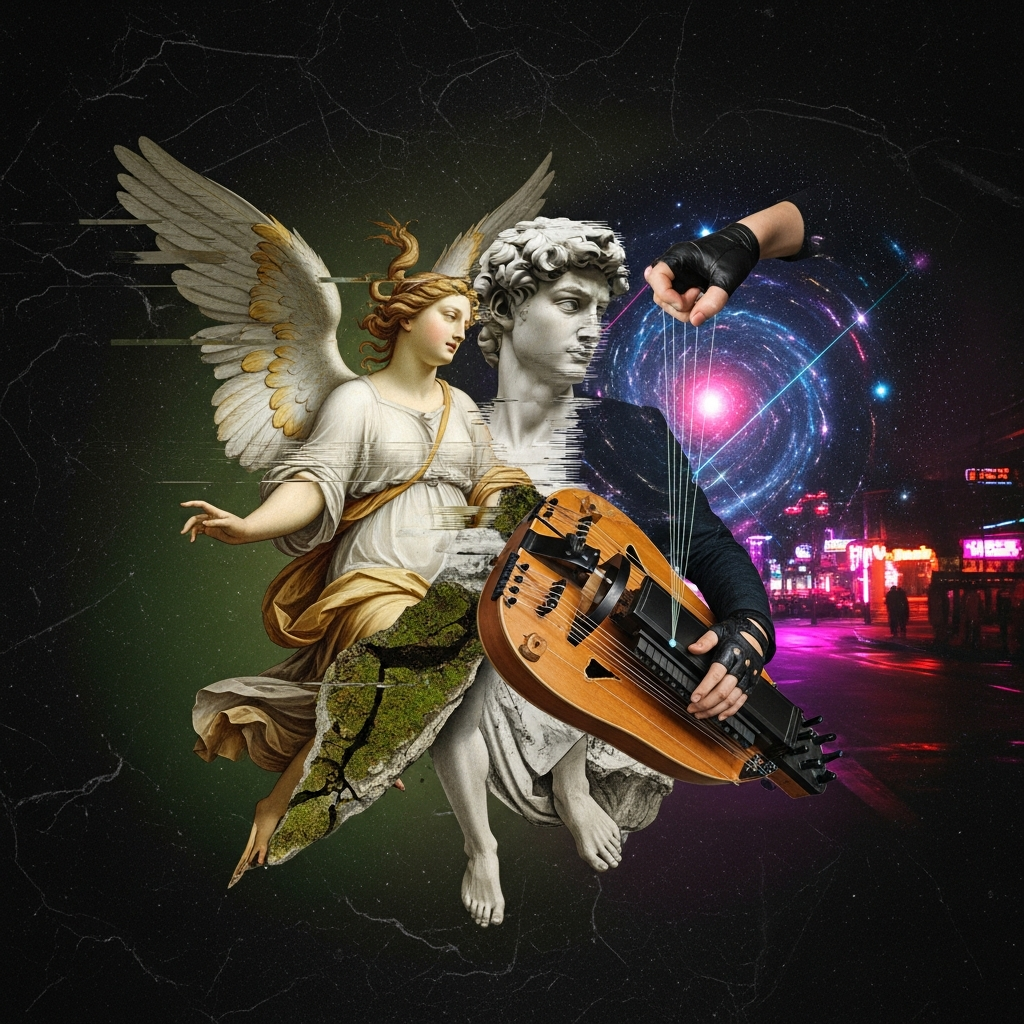
Anthropology offers a grounded perspective on why we look for gods in the clouds in the first place. Émile Durkheim argued that what we worship is often a projection of society itself. We create structures to manage the terrifying beauty of existence. Cultures build deities out of their specific needs and fears and hopes. Recognizing God as a cultural expression frees us to take responsibility for our own magic. We stop waiting for a miracle and start painting one. The realization hits you with the force of a breaking wave.
Scientific curiosity often leads us to the same conclusions as artistic intuition. Researchers in white coats have spent decades mapping the exact terrain I explore with paint. They offer empirical weight to the feeling that our spiritual experiences are homegrown rather than imported. Neuroscience reveals that the brain physically facilitates the sensation of oneness with the universe. We are hardwired for transcendence.
Psychology found a name for the state Blake lived in. Mihaly Csikszentmihalyi coined the term “Flow” to describe that optimum state of consciousness where we feel and perform our best. The ego takes a tea break during these moments. The prefrontal cortex quiets down and time creates its own strange elasticity. We do not need to attribute this trance to a muse or a ghost. It is the biology of total engagement. We become the channel simply by getting out of our own way.
Thinking With My Fingers
For me this communication with the divine arrives when I enter that flow state. Something strange happens. I become absorbed in the task. My intention amplifies but ceases to carry a heavy emotional charge. I am simply in the process. This manifests differently across the disciplines. In photography it takes the form of a strange dance where I physically move through space to find the geometry that sings. The editing phase becomes a rapid series of intuitive choices until the exact version of the image reveals itself through my hands rather than my conscious mind. It is playful and purposeful and unconscious.
Music offers a departure from the known into the unknown. I am lucky enough to play the hurdy-gurdy. The drone of the instrument opens the door to this state with startling ease. While solo play can sustain this for hours the experience transforms when shared. My band Celtarabia is built on this specific idea. We generate wild and life-affirming dance music where the gig becomes a performance for the crowd and a ritual for the players.
This process takes on a different shape with my music collaboration Agent Starling. I am given a set of instructions that include a feeling or a theme. I reflect on this to choose a fitting key and mode and time signature. Then I explore that territory whilst the recording happens. I am thinking with my fingers not my head. I have set the parameters and a playing space for musical exploration. The results are recorded raw and I return later to edit them in a second session. Even the quiet hours hold this power. I often wake early to listen to the inner voice talking. Once the writing begins the ideas flow and new paths appear to be explored.
The Paradox of Mistakes
This willingness to make a mess brings us to a vital paradox. We often find the right path only by exploring the wrong ones. The fear of error paralyzes the spirit but the embrace of the mistake liberates it. A wrong note or a stray brushstroke is not a failure. It is data. It is the universe telling you that the edge is here and not there. When I am improvising and my fingers slip they often land on a chord I would never have chosen consciously. That dissonance forces me to resolve the melody in a new way. It pushes the work into territory I could not have planned. We know we are right specifically because we have been brave enough to get it wrong. The mistake proves we are pushing against the boundaries of the known rather than simply repeating what is safe. We find our true north only by getting thoroughly lost first.
This is where the sheer frequency of the practice becomes transformative. When you show up to the page or the instrument every day you strip away the preciousness of the art. You stop treating every creation like it has to be a masterpiece and you start chasing the flow itself. We shift from a state of doing to a state of being. The practice ceases to be a chore and becomes a way to inhabit the world. It allows us to explore our inner and outer landscapes with a playful lack of judgment. In a world that worships efficiency and deliverables and bottom lines insisting on the primacy of process is an act of rebellion. We are not machines designed for output. We are gardens designed to grow.
Reclaiming the Divine
Philosophers have spent centuries trying to reclaim these treasures we mistakenly cast into the sky. Ludwig Feuerbach argued with great conviction that theology is essentially anthropology. He believed that what we call God is actually a projection of our own highest nature. We take our best qualities like love and wisdom and alienate them from ourselves by assigning them to a deity. Feuerbach urged us to take those attributes back. Friedrich Nietzsche picked up a hammer to drive this point home. His famous declaration that God is dead was a challenge rather than an ending. He wanted us to realize the “will to power” within us. The “Übermensch” is essentially a human who has realized their own potential to create values and affirm life without supernatural crutches.
Baruch Spinoza offered a perspective that feels particularly resonant for an artist who loves the natural world. He saw God and Nature as two names for the same infinite substance. This pantheistic view suggests we do not need to look up to find the divine because we are already standing in it. Paul Tillich reframed the conversation by describing the divine not as a being but as the “Ground of Being.” This shifts the focus from a beard in the sky to the raw act of existing with courage. Carl Jung mapped the internal landscape by describing gods as archetypes in the collective unconscious. He viewed spirituality as a process of individuation where we integrate the hidden parts of our psyche to achieve wholeness. These thinkers provide the intellectual bedrock for believing in our own magic.
Building Cathedrals
Contemporary visual artists continue to fan these flames. Marina Abramović uses her own body to demonstrate the sheer scale of human resilience and energy. Her performance pieces like The Artist Is Present strip away the noise to reveal the raw power of human connection. She proves that our ability to hold space for one another is a spiritual act. We must also acknowledge that the viewer is as much a part of the spiritual equation as the artist. Mark Rothko understood this perfectly. He stripped his paintings of figures and landscapes until only raw emotion remained. The Rothko Chapel stands as a testament to this power. It is a sanctuary without a dogma where massive dark canvases invite people to sit in silence. Visitors often find themselves weeping before these blocks of colour. They are having a religious experience facilitated entirely by pigment and presence. It proves we can build cathedrals out of canvas.
We can also build them out of ice and leaves. The Land Art movement reminds us that the earth itself is the ultimate studio. Artists like Andy Goldsworthy go out into the wind and the rain to stitch together leaves or balance stones. They create works of breathtaking beauty knowing full well the tide will wash them away by lunch. This is a profound spiritual stance. It embraces impermanence. It finds the sacred in the mud and the moss. It reminds us that we do not need to preserve something for it to matter. The act of creation is the prayer and the dissolving is the ‘Amen’.
A Frequency Inside Us
Music amplifies this concept by turning the vibration of the human spirit into something we can physically feel rattling our ribcages. Jimi Hendrix treated the electric guitar less like an instrument and more like a dowsing rod for the soul. He spoke of music as his religion and a way to connect with universal vibrations that bypass cultural dogma entirely. John Lennon picked up a similar thread with a quieter intensity, stripping away the divine hierarchy to reveal a humanistic unity. But for me this connection is far more personal and immediate.
The sense of timelessness and security the drone provides when I practice the hurdy-gurdy is unlike anything else. When it is strapped closely to my stomach I feel the instrument as much as I play it. It acts as an anchor and a platform that allows me to leap into the unknown. This vibration connects me to a specific lineage of sound that has always moved me. I remember the visceral bass of dub hitting deep in the stomach and making my trousers flap when I played with Suns of Arqa. I recall the trance-inducing acid house vibes of The Orb and System 7 that I heard at my first rave. I think of the soaring joyful journey of Indian ragas played by Shiv Kumar Sharma on the Santoor. These experiences are not about worshipping a distant god. They are about accessing a frequency that already lives inside us.
The Final Breath
It is hard to name that strange fluttering expectant excitement that courses through our body in the moments before starting to create. The ancients looked inward and found something that felt too vast to be entirely their own. You see this in the Christian concept of Imago Dei or the notion that we are crafted in the image of the divine. Eastern traditions like Advaita Vedanta suggest the individual soul and the universal reality are identical. These ancient maps of the spirit point to a singular truth. We are not empty vessels waiting to be filled. We are already brimming with the precise essence we search for. It forces us to ask where the line between the human and the holy actually sits.
Pierre Teilhard de Chardin famously suggested we are spiritual beings having a human experience. I take that to heart. It means the messy and chaotic and sometimes painful process of being alive is the point. Resilience becomes a spiritual practice in this light. When a painting goes wrong or life throws a curveball that knocks the wind out of you the response is the same. We wipe the palette clean. We dig deep into that steely grit and we shout “Next!” with a grin. The ability to create again after destruction is the truest evidence of our power.
Recognizing these qualities within ourselves changes the game completely for a creative practice. It transforms art from a mimicry of creation into an act of pure genesis. We tap into that boundless energy to heal and to build and to make sense of the chaos. The divine is not a destination we travel to. It is the place we are speaking from. As I turn the wheel of my hurdy-gurdy the entire universe holds its breath.
Like many writers in 2026, I use AI tools as part of my process, in this case Grok, Perplexity, Grammarly and Gemini, to help with research, brainstorming, exploration, and generating initial drafts and organising complex thoughts. However, this blog is not AI-generated content.
Every post is the result of my own research, lived experience, and extensive rewriting.
The final arguments, metaphors, and conclusions are mine alone. I disclose this because I believe the fight for human creativity begins with honesty about how we create.
 Quentin Budworth