We are living in the parenthesis between epochs. Writing from a Fascist prison cell, Antonio Gramsci described this liminal space with chilling foresight: “The crisis consists precisely in the fact that the old is dying and the new cannot be born; in this interregnum a great variety of morbid symptoms appear.”
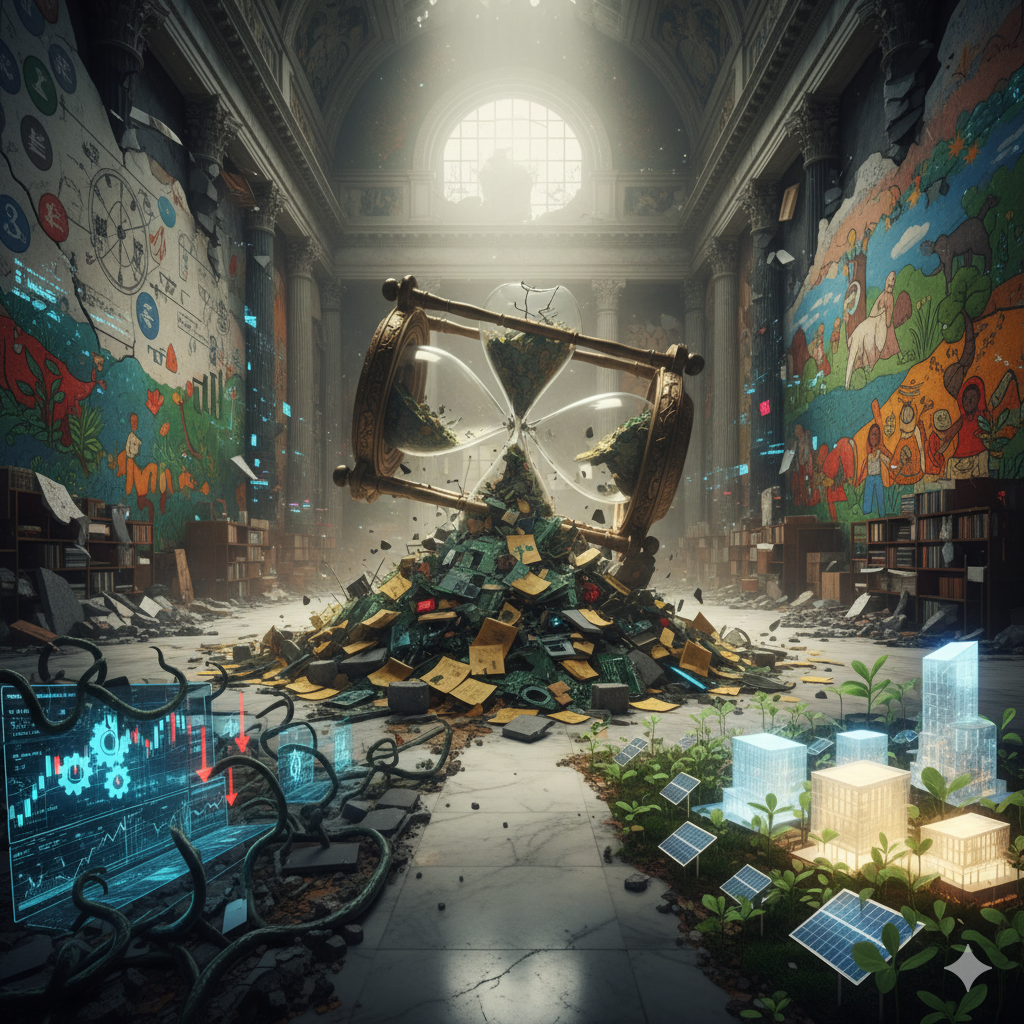
Nearly a century later, his observation feels unnervingly prescient. The world is suspended in what can be understood as a global interregnum—an extended, unsettled transition in which familiar structures of governance, economics and social order are crumbling, while coherent replacements remain only partially formed, visible more as glimpses than blueprints.
The Morbid Symptoms of Our Time
Look around. The symptoms emerge not as isolated crises, but as overlapping polycrises—a chorus of systemic failures. The neoliberal order that defined the late 20th century stutters and stalls, its promise of endless growth colliding with planetary limits and deepening inequality. In its weakening, we witness the rise of what Gramsci might have called our era’s “monsters”: authoritarianism in democratic clothing, xenophobic populism feeding on economic anxiety, and technological shifts that pledge liberation while threatening new forms of control.
Geopolitically, the world operates with multiplying centres of gravity. The post-war liberal international order—once the sun around which global politics revolved—now loses its pull. We see this in the fraying of long-standing alliances, the return of great-power tensions many thought were historical relics, and conflicts from Ukraine to Gaza that expose the limits of existing diplomatic mechanisms. The world is not yet multipolar, but it is increasingly nonpolar—a dangerous limbo where old rules no longer hold and new ones remain unwritten.
New Powers and the Vacuum They Fill
Into this vacuum step unlikely actors. Technology titans—today’s equivalent of mercenary captains—wield influence comparable to nation-states, shaping policy and public discourse with little accountability. Their platforms become our public squares; their algorithms, the invisible hands guiding economies and elections. This shift in power echoes historical interregnums, where economic forces redraw political maps long before new structures take shape.
At the same time, the environmental foundations of our civilisation show alarming fractures. Climate change embodies the ultimate polycrisis—ecological, economic, political and existential all at once. It acts as both consequence and accelerator of our interregnum, revealing how the old growth model now feeds on its own collapse.
The Spectrum of Possible Futures
Where does this lead? Several paths branch from our present uncertainty:
- The Authoritarian Resolution: Democratic norms erode further, replaced by digital surveillance states and corporate-backed strongmen offering stability in exchange for freedom.
- The Progressive Transformation: A deliberate, difficult turn toward regenerative economics, participatory democracy and global cooperation centred on sustainability and equity.
- The Chaotic Fragmentation: Current trends deepen into systemic failure—more collapsed states, global trade splintered into hostile blocs, climate displacement triggering unprecedented crises.
- The Techno-Oligarchic Horizon: Power consolidates not in nations but in corporate entities controlling essential technologies, from AI to bioengineering, creating a digital feudalism.
Navigating the In-Between
What the idea of interregnum emphasises is agency. This is not just something happening to us; it is a space we inhabit and can shape. The “morbid symptoms” are warnings, not inevitabilities.
Meaningful response means acting on multiple levels at once:
Politically, we must reinvent multilateralism for a fragmented world—creating spaces for dialogue that recognise new power realities without abandoning human rights.
Economically, we need to build resilience—localising essential supplies while sustaining global cooperation, testing post-growth models that do not equate progress with extraction.
Technologically, we must set ethical boundaries before capability outruns governance, especially with artificial general intelligence approaching as either a vital tool or an existential risk.
Ecologically, the task is a just transition—moving rapidly beyond fossil fuels while supporting communities disrupted by both climate impacts and economic change.
Labour Pains of What Comes Next
Perhaps the hardest part of living through an interregnum is psychological. We are conditioned to expect linear progress or cyclical return, not this prolonged disorientation. The temptation is to retreat into nostalgia for a simpler past or to surrender to despair.
And yet history suggests these between-times, however painful, are also spaces of remarkable creativity. The Renaissance emerged from medieval crisis. The modern international system was born from world war’s ashes. The old must decay enough to make room for the new.
Our task, then, is not to wish the interregnum away, but to move through it with clear sight and steady will. To help birth the “new” waiting to emerge—systems centred on ecological renewal rather than extraction, on fair distribution rather than accumulation, on shared governance rather than concentrated power.
The parenthesis will close. What follows depends profoundly on what we choose to nurture in this uncertain, fertile and dangerous in-between. The interregnum is not our destination, but our crucible. What emerges from it will be shaped by what we value, whom we stand with and the courage we find in this twilight of an old world.
Like many writers in 2026, I use AI tools as part of my process, in this case Grok, Perplexity, Grammarly and Gemini, to help with research, brainstorming, exploration, and generating initial drafts and organising complex thoughts. However, this blog is not AI-generated content.
Every post is the result of my own research, lived experience, and extensive rewriting.
The final arguments, metaphors, and conclusions are mine alone. I disclose this because I believe the fight for human creativity begins with honesty about how we create.
 Quentin Budworth