Tag Archives: #MediaLiteracy

The Sleep of Reason: Why Goya’s Monsters are Winning in 2026

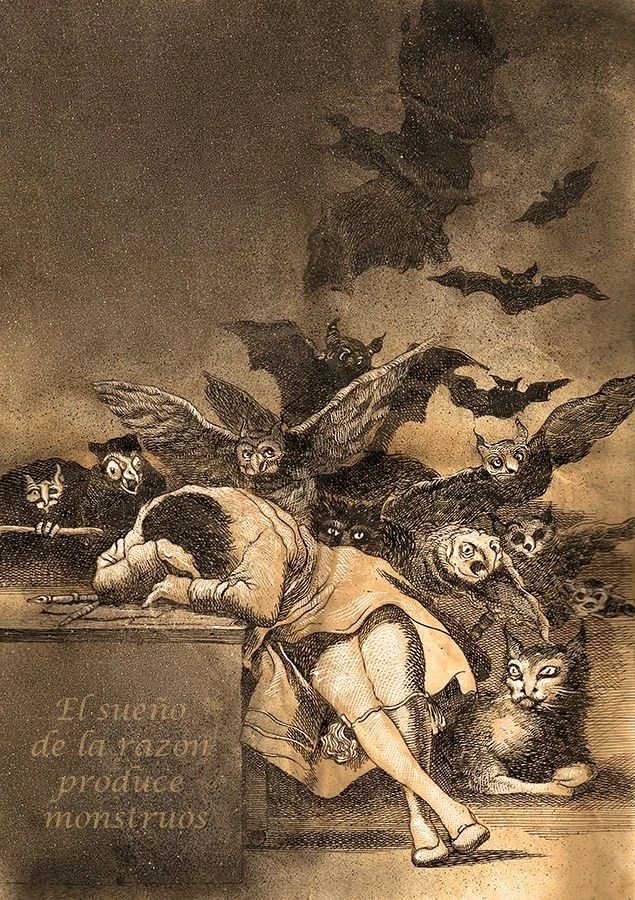
In Francisco Goya’s 1799 etching, The Sleep of Reason Produces Monsters, the artist is not merely napping. He has collapsed. His tools, the pens and paper of the Enlightenment, lie abandoned on the desk. Behind him, a swarm of owls and bats emerges from the blackness.

Goya’s Los Caprichos served as a warning to Spanish society, blinded by superstition and corruption. But today, the etching feels like a live-stream of the 2026 news cycle.

When reason sleeps, we don’t just dream of monsters. We build them.

The New Bestiary: Algorithms and Echoes

In the post-truth era, the “monsters” are digital. They are the algorithms that prioritise cortisol over comprehension.

According to the 2025 Digital News Report, we have reached a tipping point: 47% of the global population now identifies national politicians and “influencers” as the primary architects of disinformation. Reason hasn’t just faltered; it has been outsourced to partisan actors who benefit from its absence.

The Arendtian Nightmare

The political philosopher Hannah Arendt understood that the goal of total deception is not to make people believe a lie. It is intended to ensure that they can no longer distinguish between truth and falsehood.

In her 1967 essay Truth and Politics, Arendt warned that factual truth is “manoeuvred out of the world” by those in power. We see this today in the “defactualisation” of our economy. Despite rising consumer prices and growing unemployment, a barrage of “official” narratives in 2025 and 2026 has attempted to frame the economy as flawless. As Arendt predicted, when the public is subjected to constant, conflicting falsehoods, they don’t become informed—they become cynical and paralysed.

The Outrage Addiction

Why do we let the monsters in? Because they feel good.

Neuroscience tells us that outrage is a biological reward. A landmark study by Dominique de Quervain showed that the act of “punishing” a perceived villain lights up the dorsal striatum—the brain’s pleasure centre.

Social media is essentially a delivery system for this chemical hit. We are trapped in a cycle in which we conflate “online fury” with “social change.” This outrage functions as a smokescreen: while we argue over individual “villains” on our feeds, the structural monsters: inequality, surveillance, and capture – continue their work undisturbed.

The Architecture of the 1%

While the public is distracted by the digital swarm, wealth has been consolidated into a fortress. In 2026, the global wealth gap is no longer a gap; it is a chasm.

  • The Fortune: Billionaire wealth hit $18.3 trillion this year, an 81% increase since 2020.
  • The Control: The top 1% now own 37% of global assets, holding eighteen times the wealth of the bottom 50% combined.

This concentration of capital is the ultimate “monster.” It allows a tiny elite—who are 4,000 times more likely to hold political office than the average person—to dictate the boundaries of reality.

Cognitive Atrophy: The AI Trap

Our most vital tool for resistance, the human mind, is being blunted. A 2025 MIT study confirmed that heavy reliance on Large Language Models (LLMs) for critical thinking tasks correlates with weakened neural connectivity and a “doom loop” of cognitive dependency.

As the Brookings Institution warned in early 2026, we are witnessing a “cognitive atrophy.” If we offload our judgment to machines owned by the 1%, we lose the very faculty required to recognise the monsters in the first place.

Case Study: The Epstein Files and Systemic Silence

The release of 3 million pages of Epstein documents in January 2026 should have been a moment of total reckoning. With 300 “politically exposed persons” implicated—from British peers to European heads of state, the scale of the rot is undeniable.

Yet, the reaction has been a repeat of Goya’s etching. We focus on the “monsters” (the names in the files) while ignoring the “sleep” (the legal impunity and wealth-purchased silence) that enabled their existence. Epstein was not a glitch in the system; he was a feature of it.

Waking the Artist

Goya’s etching ends with a caption: “Imagination abandoned by reason produces impossible monsters; united with her, she is the mother of the arts and the source of their wonders.”

To wake up in 2026 requires more than “fact-checking.” It requires a reclamation of our tools:

  1. Cognitive Sovereignty: Limit the AI-driven “doom loop” and reclaim the capacity for independent analysis.
  2. Structural Sight: Stop chasing the “bats and owls” of individual outrage and look at the “desk”—the economic and political structures that house them.
  3. Institutional Integrity: Support the few remaining impartial bodies capable of holding power to account.

The monsters only vanish when the artist wakes up. It is time to pick up the tools.


Key References

Autocracy in the digital space.

We were all raised on stories of obvious tyranny. We were taught to look for the book burnings and the public shamings. We were told to listen for the sound of the cage door slamming shut. But what happens when the cage has no bars? What happens when the prison isn’t a place, but a state of mind, meticulously constructed to feel like freedom?

This is the world of informational autocracy. It’s a far slicker, more sophisticated beast than the clumsy dictatorships of the last century. It doesn’t need to rule by fear when it can rule by manufactured consent. This new model of power doesn’t abolish elections; it mimics them, ensuring the outcome is a foregone conclusion while maintaining a veneer of legitimacy. It doesn’t ban the free press; it buys it, starves it of advertising, or floods the zone with so much state-sponsored noise that the truth is simply drowned out. Look at Putin’s Russia, Orbán’s Hungary, or Erdoğan’s Turkey. The playbook is the same: project an image of competence and stability, paint all opposition as chaotic or treacherous, and ensure the majority of the public never gets a clear enough signal to know the difference. The primary goal is not to terrorise the population, but to convince them. And the engine room of this entire operation is the device in your pocket.

Enter the social media platform: the greatest accelerator of informational autocracy ever invented. These systems are not neutral tools; they are battlegrounds designed for a very specific kind of warfare. Their algorithms, built not for truth but for traffic, are perfectly tuned to reward the divisive, the sensational, and the outrageous. It’s no accident that, on platforms like X, false political stories are proven to spread 70% faster than the truth. Outrage is profitable. Division drives engagement. In this environment, an autocrat’s propaganda isn’t just another post—it’s premium fuel for a machine designed to run on it. We are not just the audience; we are the unwitting foot soldiers, sharing and amplifying narratives that fracture our own societies. But this battle isn’t just for the hearts and minds of the masses. There’s a more specific, more strategic target in its sights.

Every society has an “informed elite”—that small but crucial group of journalists, academics, professionals, and artists who have the access and the training to see through the noise. In the old world, an autocrat had to arrest or exile them. In the new world, the strategy is far more subtle. Social media allows the regime to monitor them, identifying dissenters for a quiet campaign of shadow-banning, legal threats, or professional exclusion. Even more effectively, it allows them to be co-opted. A slice of the elite is turned into well-paid influencers, their credibility used to launder regime propaganda. The very tool that could expand the ranks of the informed by democratizing information also shatters their authority, turning public discourse into a chaotic free-for-all where a verified expert has the same algorithmic weight as a state-funded troll farm.

It leaves us in the crossfire of a silent, borderless war. The tactics perfected in Moscow and Beijing are now exported globally, seeping into the bedrock of democracies. This is the slow poison: the erosion of public trust, the exhaustion of civic life, and the creeping sense that objective truth no longer exists. This is the ultimate goal. The aim isn’t just to win an argument; it’s to create an environment where the very idea of a shared reality seems naive. It is to foster a deep, weary cynicism that leads to democratic fatigue, where we disengage not because we are forced to, but because we are too tired to continue.

So, what is the way out? It is not to find a mythical, uncompromised platform or to wait for a single heroic leader. The resistance begins with a conscious and deliberate act of what can only be called informational hygiene. It starts with us. We must become fierce curators of our own information, deliberately seeking out and paying for quality, independent journalism. We must take our conversations offline and into the real world, rebuilding the connective tissue of society in our own communities. And above all, we must build our own resilience as if it were armour. They are counting on our burnout. An exhausted, cynical public is their ideal political landscape.

This is the work. It is not glamorous. It is not easy. But it is real. The most radical act in an age of quiet persuasion is a loud and curious mind. Keep yours sharp. Keep it open. And never, ever let them convince you to close it.

Your Burnout Is Their Political Strategy

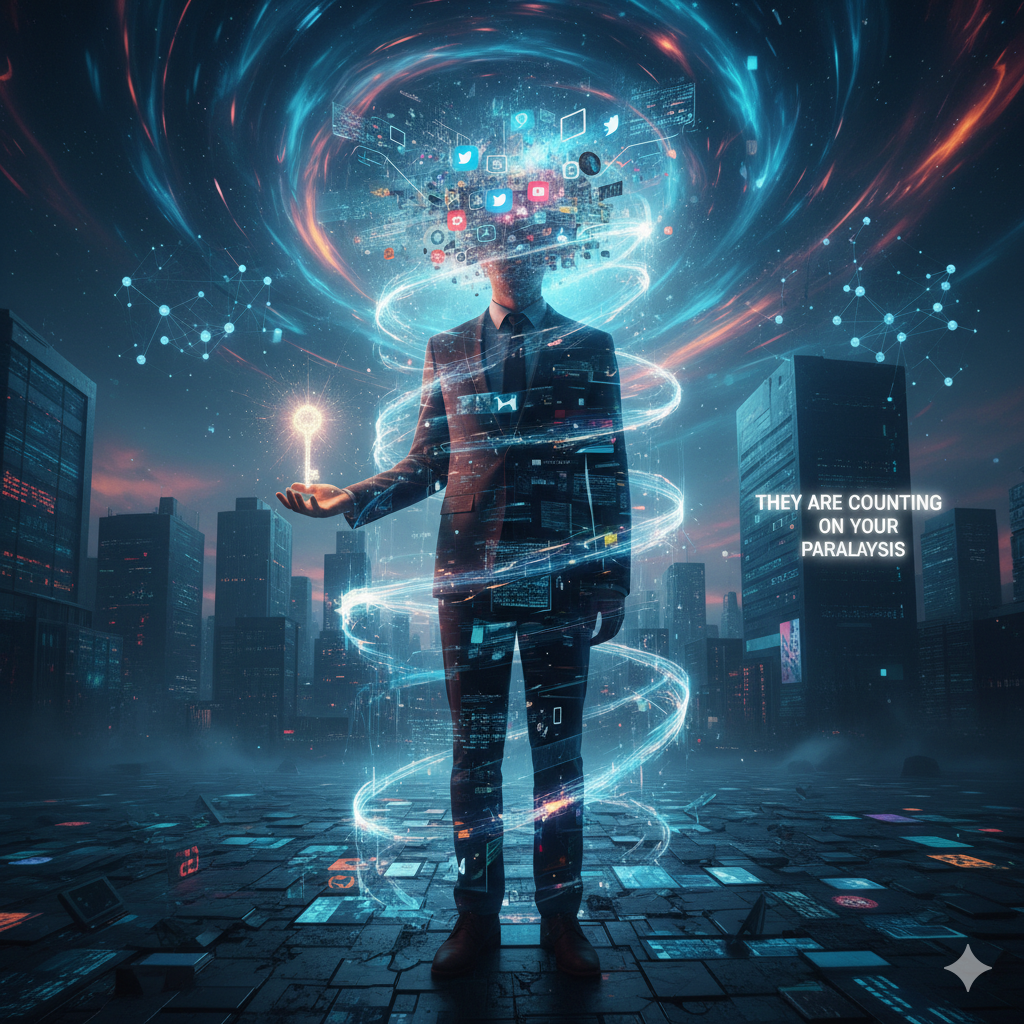
Fascism has changed, as kids we were taught to look out for the jackboots and salutes now the bars aren’t made of iron anymore; they’re made of information, and the prison isn’t a place, but a state of mind. It’s one thing to see the shape of this new cage, but another thing entirely to know how to unlock the door. The sheer scale of it all can feel paralysing. That is precisely what they are counting on. But the antidote isn’t a single, heroic act of rebellion. It’s the small, consistent, and deliberate practice of clear-headed defiance. These individual acts aren’t the endgame, though. They are the training ground for rebuilding public trust and collective power from the ground up.

So here’s what you do.

First, become a fierce curator of your information and a trusted amplifier of the truth. Stop doomscrolling. Stop passively accepting the algorithm’s feed as reality. Deliberately seek out independent voices, local journalists, and long-form content. If you can afford it, pay for quality journalism; it is the last line of defence. And once you find a piece of solid reporting or a vital local story, your job is to share it. Not by screaming into the void online, but by sending it directly to three or five people in your life who you know will take it seriously. Be the signal, not the noise.

Second, take your conversations from the social sphere into the civic one. Breaking your echo chamber is vital, but it cannot end with a chat over a pint. You must take that renewed understanding offline and into the real world. Join something. A local library, a school parents’ association, a tenants’ union, a conservation group. Find the most boring-sounding local committee you can. Power abhors a vacuum, and these hyper-local spaces have been abandoned, left to those with narrow agendas. Go and fill them. This is where the connective tissue of society is either woven or unravels. This is the difference between talking about politics and doing politics.

Finally, build your resilience as if it were armour, because it is. Recognise that this fight is a marathon, not a sprint. They are counting on your burnout. An exhausted, cynical, and overwhelmed public is their ideal political climate. Every time you log off, go for a walk, and come back clear-headed, you are actively thwarting a political strategy. Replenish your spirit not as an escape, but as a necessary act of training for the long road ahead. A resilient, clear-headed, and good-humoured citizen is a nightmare for those who rely on our exhaustion.

This is the work. It is not glamorous. It is not easy. But it is real. The most radical act in an age of quiet persuasion is a loud and curious mind. Keep yours sharp. Keep it open. And never, ever let them convince you to close it.

Above all, choose hope and vote Green.