Tag Archives: news

Flipping the Switch: The Digital Pound in the Wrong Hands

The Digital Pound: A Tyrant’s Dream Come True.

You’ve heard all the promises about the Digital Pound. That it’s safe. That your privacy is guaranteed. But you have to ask yourself one brutal question: what happens when the people making those promises are gone? Because in the hands of an authoritarian regime, the system they are building today becomes the perfect weapon for controlling you tomorrow. This isn’t an academic exercise; it’s a warning. The infrastructure of a digital cage is being assembled right now, and what matters isn’t the current design, but what it will become in the wrong hands.

This isn’t just an academic exercise. History is littered with democracies that faltered. To build this infrastructure without considering the worst-case scenario is not just naive; it is reckless. In the event of an authoritarian takeover, the digital pound, linked to a Digital ID, would not be a tool of convenience. It would be the most perfect instrument of state control ever conceived.

The first and most immediate change would be the weaponisation of surveillance. All the current safeguards—GDPR, promises of data privacy, the separation between the Bank and private wallet providers—would be swept away overnight. An authoritarian state would rewrite the laws, bypass regulations, or simply coerce private companies to hand over the data. The system is already designed for traceability; a new regime would just have to point it in the right direction. Every transaction, every donation, every purchase would become an open book to the state, revealing your networks, your beliefs, and your loyalties. Financial privacy would cease to exist.

This leads directly to the next implication: conditional access to your own life. Today, they promise it’s a choice. Under an authoritarian regime, that choice would vanish. The digital pound would become mandatory, and cash, the last bastion of anonymity, would be aggressively phased out. We’ve seen how quickly existing financial systems can be turned against citizens. During the 2016 coup attempt in Turkey, the government froze the bank accounts of thousands of suspected dissidents. A digital pound would make this process frictionless and absolute.

Your access to money, and therefore your ability to buy food, pay rent, or travel, would be tied directly to your compliance. A centralised Digital ID would become the linchpin of a social credit system, where your right to participate in the economy is granted or denied based on your loyalty to the regime. Step out of line, and you could be switched off. Not arrested, not charged, just silently and efficiently excluded.

With this power, our fundamental civil liberties would be dismantled. The right to protest, to assemble, and to speak freely would be neutered. An authoritarian state could reprogramme the digital pound in an instant. It could block donations to opposition groups, restrict travel to protest locations, or even limit what you are allowed to purchase. The “silent denial of a transaction” would become the state’s most effective tool for suppressing dissent, creating a chilling effect that would silence opposition far more effectively than any police force.

And in a final, devastating step, such a regime could use the digital pound to manipulate the economy for its own ends. It could issue “helicopter money” directly into citizens’ wallets to shore up loyalty, but with strings attached—programmable funds that can only be spent on state-approved goods. It could even revalue the currency overnight, forcing everyone into the new system and wiping out the savings of those who resist.

The democratic checks and balances we rely on today are fragile. They can be eroded or dismantled. The infrastructure we build, however, is permanent. To create a centralised system that fuses identity and money is to build a cage. We may be promised that the door will remain unlocked, but in the hands of an authoritarian ruler, that door would be slammed shut and bolted. The Digital Pound would become the ultimate enforcer, turning every citizen into a subject, their freedom contingent on the flick of a switch.

https://www.bankofengland.co.uk/the-digital-pound

Your New Digital ID Isn’t For Convenience. It’s For Control.


The Digital Back Door: Why a National ID is the End of a Free Society

Every breath you take
And every move you make
Every bond you break
Every step you take
I’ll be watching you

Lyric George Sumner – The Police

There’s a pitch being sold to the British public, dressed up in the language of convenience and national security. It’s the idea of a Digital ID for every adult, a neat, modern solution to complex problems like illegal migration.

I can tell you this isn’t progress. It’s the architecture of a control system, a Trojan horse that smuggles a surveillance state in under the guise of efficiency. It is the end of a free society, and we are sleepwalking towards it.

Let’s start by dismantling the primary justification: fixing the border. The claim that a Digital ID will stop the boats is, to put it plainly, bollocks. It will not stop trafficking gangs, nor will it fix a fundamentally broken system. Criminals and their networks are, by their very nature, experts at working around systems; they adapt faster than bureaucracies can legislate. The ones who will pay the price for this vast, expensive, and dangerous infrastructure will not be the criminals, but the honest, law-abiding citizens of this country.

The fundamental flaw lies in a concept I deal with daily: centralised risk. We spend hundreds of billions a year on cybersecurity, yet the volume and severity of data breaches are breaking records. The threat grows faster than the spend. From Jaguar Land Rover to major airports, no centralised system has proven impenetrable. Now, imagine that vulnerability scaled up to a national level, with a single database linking your identity to every checkpoint of daily life: where you go, what you buy, what you read, and who you speak to.

Here is the risk that ministers will not admit. A sophisticated ransomware attack, seeded quietly through a compromised supplier or a disgruntled insider, lies dormant for months. It slowly rolls through the backups, undetected. Then, on trigger day, the live registry and every recovery set are encrypted simultaneously. The country grinds to a halt. Payments fail. Health and benefits systems stall. Borders slow to a crawl. Citizens are frozen out of their own lives until a ransom is paid or the state is forced to rebuild the nation’s identity from scratch. To centralise identity is to centralise failure.

This, however, is only the technical risk. The greater political and social danger lies in the certainty of function creep. It will begin as an optional, convenient way to log in or prove your age. But it will not end there. It will inevitably become a mandatory prerequisite for accessing money, travel, employment, and essential public services. Our fundamental rights will be turned into permissions, granted or revoked by the state and its chosen corporate contractors.

This isn’t a theoretical dystopian future; it’s a documented reality. India’s Aadhaar system, initially for welfare, now underpins everything from banking to mobile phones and has been plagued by data leaks exposing millions to fraud. We are seeing the groundwork laid in the UK with the Digital Identity and Attributes Trust Framework (DIATF), a federated model reliant on a network of private suppliers like Yoti, Hippo Digital, and IDEMIA. This multi-vendor approach doesn’t eliminate risk; it multiplies the potential points of failure through a web of interconnected APIs, each a potential back door for attackers.

Furthermore, this system is built on a foundation of exclusion. The assumption of universal digital literacy is a dangerous fiction. With a significant percentage of UK adults lacking basic digital skills, a mandatory Digital ID will create a two-tier society. The elderly, the poor, and the vulnerable—those who cannot or will not comply—risk being locked out of the services they need most, deepening inequality and fuelling social unrest.

The gravest danger, however, emerges when this infrastructure is placed in the context of a crisis. Economic collapse, social unrest, or an environmental emergency often serves as the justification for an expansion of state power. A Digital ID system provides the ready-made tool for authoritarianism. In a crisis, it could be repurposed to monitor dissent, freeze the bank accounts of protesters, or restrict the movement of individuals deemed a threat. It builds, by stealth, the machinery for a social credit system.

And this brings us to the corporate engine waiting to power this machine: Palantir. The US data-mining firm is already deeply embedded within the UK state, with contracts spanning the NHS and the Ministry of Defence. Palantir doesn’t need a specific contract for the “Brit Card”; its platforms, Foundry and Gotham, are designed to do precisely what a Digital ID enables on a mass scale: fuse disparate datasets into a single, all-encompassing profile for every citizen.

The Digital ID would be the “golden record” that connects your health data, your financial transactions, your movements, and your communications. In a crisis, Palantir’s AI could be used for predictive surveillance—flagging individuals who enter a “protest zone” or transactions to “undesirable” organisations. This isn’t just a British system; with Palantir’s deep ties to US intelligence, it becomes a system subject to foreign demands under legislation like the CLOUD Act. We would be outsourcing our national sovereignty.

The entire premise is flawed. If the government were serious about the border, it would enforce current laws, properly resource patrols and processing, and close existing loopholes. You do not need to build a panopticon to do that. We scrapped ID cards in 2010 for a reason, recognising their threat to our fundamental liberties. Reintroducing them through the digital back door, outsourced to a network of private contractors and data-mining firms, is a monumental error.

There are better ways. Decentralised alternatives using cryptographic methods like zero-knowledge proofs can verify status or identity without creating a central honeypot of data. But these privacy-first solutions lack government traction because the true, unstated goal is not security or convenience. It is control. We must not fall for the pitch. This is a system that will centralise risk and outsource blame. It will punish the vulnerable while failing to stop the criminals it targets. It is the foundation for a future where our rights are contingent on our compliance. The choice is simple: yes to privacy-first proofs, no to a database state.

Beware the all-seeing eye!

The UK Didn’t Just Sign a Tech Deal – It Handed Over the Keys.

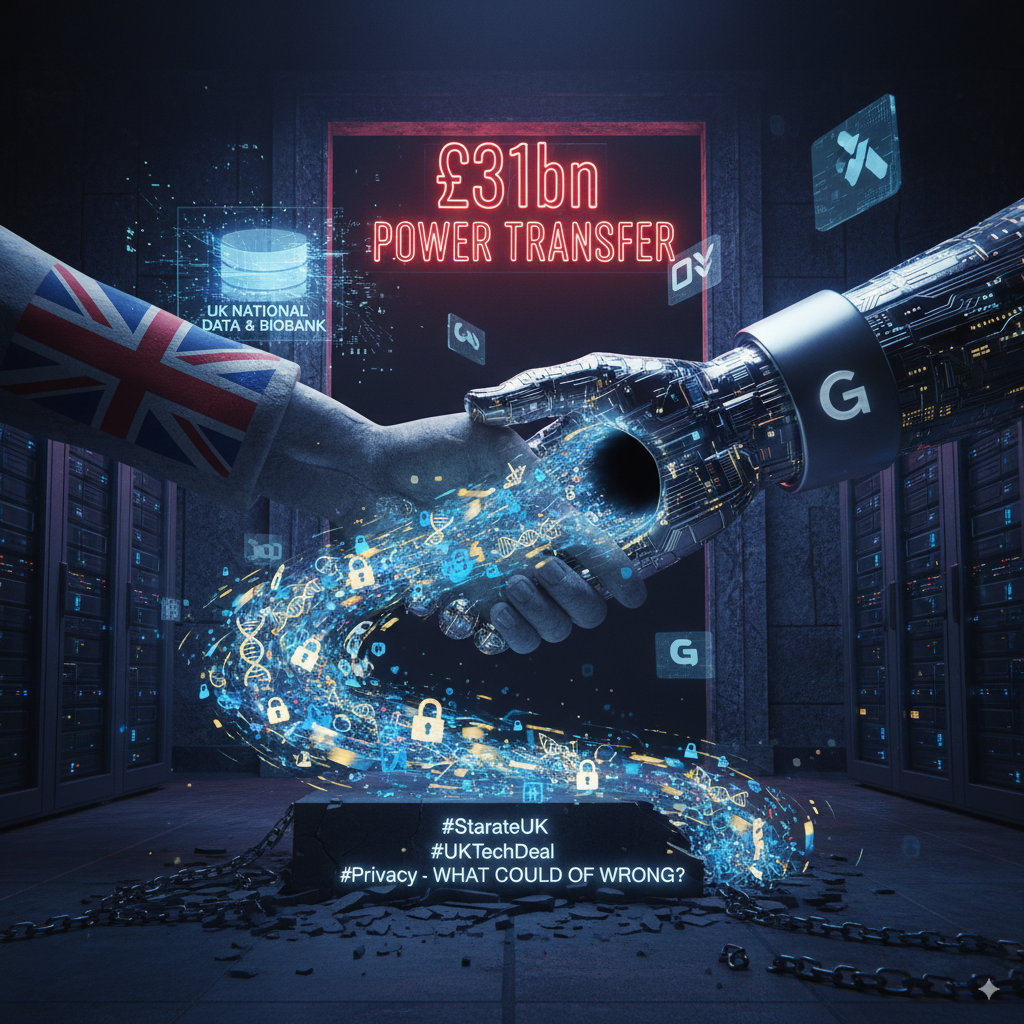
Whilst all eyes are on Trump at Windsor the UK Government announced the “Tech Prosperity Deal,” a picture is emerging not of a partnership, but of a wholesale outsourcing of Britain’s digital future to a handful of American tech behemoths. The government’s announcement, dripping with talk of a “golden age” and “generational step change,” paints a utopian vision of jobs and innovation. But peel back the layers of PR, and the £31 billion deal begins to look less like an investment in Britain and more like a leveraged buyout of its critical infrastructure.

At the heart of this cosy relationship lies a bespoke new framework: the “AI Growth Zone.” The first of its kind, established in the North East, is the blueprint for this new model of governance. It isn’t just a tax break; it’s a red-carpet-lined, red-tape-free corridor designed explicitly for the benefit of companies like Microsoft, NVIDIA, and OpenAI. The government’s role has shifted from regulation to facilitation, promising to “clear the path” by offering streamlined planning and, crucially, priority access to the national power grid—a resource already under strain.

While ministers celebrate the headline figure of £31 billion in private capital, the true cost to the public is being quietly written off in the footnotes. This isn’t free money. The British public is footing the bill indirectly through a cascade of financial incentives baked into the UK’s Freeport and Investment Zone strategy. These “special tax sites” offer corporations up to 100% relief on business rates for five years, exemptions from Stamp Duty, and massive allowances on capital investment. For every pound of tax relief handed to Microsoft for its £22 billion supercomputer or Blackstone for its £10 billion data centre campus, that is a pound less for schools, hospitals, and public services.

Conspicuously absent from this grand bargain is any meaningful protection for the very people whose data will fuel this new digital economy. The deafening silence from Downing Street on the need for a Citizens’ Bill of Digital Rights is telling. Such a bill would enshrine fundamental protections: the right to own and control one’s personal data, the right to transparency in algorithmic decision-making, and the right to privacy from pervasive state and corporate surveillance. Instead, the British public is left to navigate this new era with a patchwork of outdated data protection laws, utterly ill-equipped for the age of sovereign AI and quantum computing. Without these enshrined rights, citizens are not participants in this revolution; they are the raw material, their health records and digital footprints the currency in a deal struck far above their heads.

What is perhaps most revealing is the blurring of lines between the state and the boardroom. The government’s own press release celebrating the deal reads like a corporate shareholder report, quoting the CEOs of NVIDIA, OpenAI, and Microsoft at length. Their voices are not presented as external partners but as integral players in a shared national project. When Sam Altman, CEO of OpenAI, declares that “Stargate UK builds on this foundation,” it raises the fundamental question: who is building what, and for whom?

This unprecedented integration of Big Tech into the fabric of national infrastructure raises profound questions about sovereignty and control. These data centres and supercomputers are not just buildings; they are the “factories of the future,” processing everything from sensitive healthcare data from the UK Biobank to research that will define our national security. By handing the keys to this infrastructure to foreign entities, the UK risks becoming a digital vassal state, reliant on the goodwill and strategic interests of corporations whose primary allegiance is to their shareholders, not to the British public.

The “Tech Prosperity Deal” has been sold as a triumph of post-Brexit, “Global Britain.” But the reality is far more sobering. It is a deal that sees the government leveraging its power to reduce tax income, strain the national grid, and cede control of critical infrastructure, all to entice a handful of the world’s most powerful companies. The handshake may have been for £31 billion, but the price of Britain’s digital independence could prove to be far higher.


Further Reading and Sources

Official Government Announcements and Policies:

Digital Rights and Privacy Advocacy:

  • Open Rights Group: A leading UK organisation campaigning for digital rights and privacy, with analysis on AI and data protection.
  • Big Brother Watch: Investigates and challenges threats to civil liberties, including state surveillance and the use of private data.

Data and Infrastructure Context:

I understand your concerns about the recent deal between the UK government and Big Tech, especially regarding data privacy and national security. It’s a complex issue with various potential implications.

On one hand, proponents of the deal might argue that collaborations with leading technology companies can bring significant benefits, such as:

  • Economic Growth: Attracting investment and creating jobs in the tech sector.
  • Technological Advancement: Gaining access to cutting-edge research, development, and infrastructure that could boost the UK’s scientific and technological capabilities.
  • Improved Public Services: Utilizing advanced data analytics and cloud computing to enhance efficiency and effectiveness in areas like healthcare (e.g., accelerating medical research through projects like the UK Biobank) and national security.
  • Global Competitiveness: Ensuring the UK remains a key player in the global digital economy.

Concerns about data sovereignty and the potential risks are valid. Here are some of the “what ifs” that often arise in discussions like this:

  • Data Security and Privacy:
    • Breaches: The risk of data breaches increases when sensitive information is stored and processed by third-party corporations, regardless of their size or security measures.
    • Jurisdiction: In cases of international corporations, questions arise about which country’s laws apply to data privacy and protection, potentially complicating legal recourse for UK citizens.
    • Usage of Data: Concerns about how this data might be used beyond the stated purpose, including for commercial gain or even by foreign governments, especially if those corporations are subject to laws in their home countries that compel data access.
  • National Security Implications:
    • Foreign Influence: The potential for foreign governments to gain indirect access to sensitive national security research or infrastructure through these corporations.
    • Critical Infrastructure: If essential services become overly reliant on foreign-owned tech infrastructure, it could pose a risk during international disputes or cyber-attacks.
  • Loss of Control and Sovereignty:
    • Policy Influence: Big Tech companies wield significant influence, and collaborations could lead to their greater sway over UK policy and regulatory frameworks.
    • Dependence: Becoming overly dependent on specific foreign providers could limit the UK’s long-term strategic autonomy in the digital sphere.
  • Ethical Considerations:
    • Bias in Algorithms: If AI and data analytics tools provided by these companies are used in public services, there’s a risk of embedded biases affecting outcomes for citizens.
    • Transparency: The level of transparency around how data is managed, accessed, and secured by these corporations can be a major point of contention.

These are all important points for public discussion and robust oversight. Governments typically try to mitigate these risks through strict contractual agreements, data protection regulations (like GDPR in the UK), independent audits, and national security assessments. The effectiveness of these safeguards is often the subject of ongoing debate and scrutiny.

Trump And Musk A Modern Punch And Judy Show Engineered To Distract

It is Punch and Judy on the world stage, a performance designed to distract, confuse, and entertain. We get so caught up in the political drama that we miss what is happening behind the curtain. The political theorist Noam Chomsky has warned of this for decades, calling it the “illusion of debate”, an enchanting spectacle where we are encouraged to argue, heckle, and voice an outraged opinion, but only about things that don’t truly matter.

Chomsky put it bluntly: “The smart way to keep people passive and obedient is to strictly limit the spectrum of acceptable opinion, but allow lively debate within that spectrum.” We are led into a room and told we can rearrange the furniture as much as we like, but we must never think to knock down the walls. This keeps us feeling engaged while the fundamental systems that shape our lives remain unchallenged.

The high-profile feud between Donald Trump and Elon Musk is a perfect modern case study. The rolling news coverage presents a spectacular public blow-up, with Trump threatening to cut Musk’s multi-billion-dollar government contracts and Musk firing back with personal insults. It feels dramatic and significant.

But while we are glued to our screens, watching the meme wars unfold on social media, we miss the real story: both men are beneficiaries and proponents of the same system. Their public theatre distracts from their shared interest in maintaining corporate power. Trump’s landmark 2017 Tax Cuts and Jobs Act slashed the corporate tax rate from 35% to 21%. Meanwhile, Musk’s companies, such as SpaceX and Tesla, have raked billions from government contracts and subsidies, benefiting from policies that were advanced during the Trump administration and beyond. Despite the public spats, their economic interests align in opposing higher taxes on the wealthy and promoting deregulation.

This is the illusion of debate in action. While the media profits from the drama, critical policy decisions are made in the shadows. Investigations into corporate malpractice are quietly halted, labour laws are weakened, and environmental regulations are rolled back. The spectacle keeps the public divided and misinformed, undermining democratic accountability and preventing any unified challenge to a status quo that overwhelmingly favours elite interests.

This tactic is not new. From the Reagan-era tax cuts sold as “trickle-down economics” to the Clinton-era financial deregulation that paved the way for the 2008 crash, political theatre has long been used to divert public attention while corporate agendas advance.

So, what can we do? The first step is to recognise the performance for what it is. We must learn to ask better questions: not “Whose side are you on?” but “Who benefits from this entire system?

Secondly, we must actively seek out diverse sources of information, particularly independent journalism that is not beholden to corporate advertisers or political factions. This allows us to see the whole picture, not just the carefully framed sliver presented to us.

Finally, we need to engage with politics more meaningfully. This means focusing on policy, not personality. It means getting involved locally, where our voices have a tangible impact. History shows that it is possible when people come together to demand systemic change. Breaking the spell of the illusion is not just an act of intellectual curiosity but a vital act of democratic self-defence.

Additional Information and Resources:

Table: Summary of Hidden Agendas and Mechanisms:

Hidden AgendaDescriptionMechanism
Maintaining Corporate ControlEnsure corporate-friendly policies are implemented without opposition.Divert attention from lobbying and policy changes.
Protecting Elite InterestsProtect wealth and power of elites, including billionaires.Keep public divided and entertained, preventing unified action.
Manipulating Public PerceptionShape opinion in favor of status quo or corporate agendas.Frame issues as personal conflicts, influencing priorities.
Undermining Democratic AccountabilityReduce accountability of officials and corporate leaders.Distract from transparency demands, focusing on spectacle.
Generating Media ProfitsIncrease viewership and revenue for media companies.Amplify sensational stories for higher ratings and engagement.

Key Citations