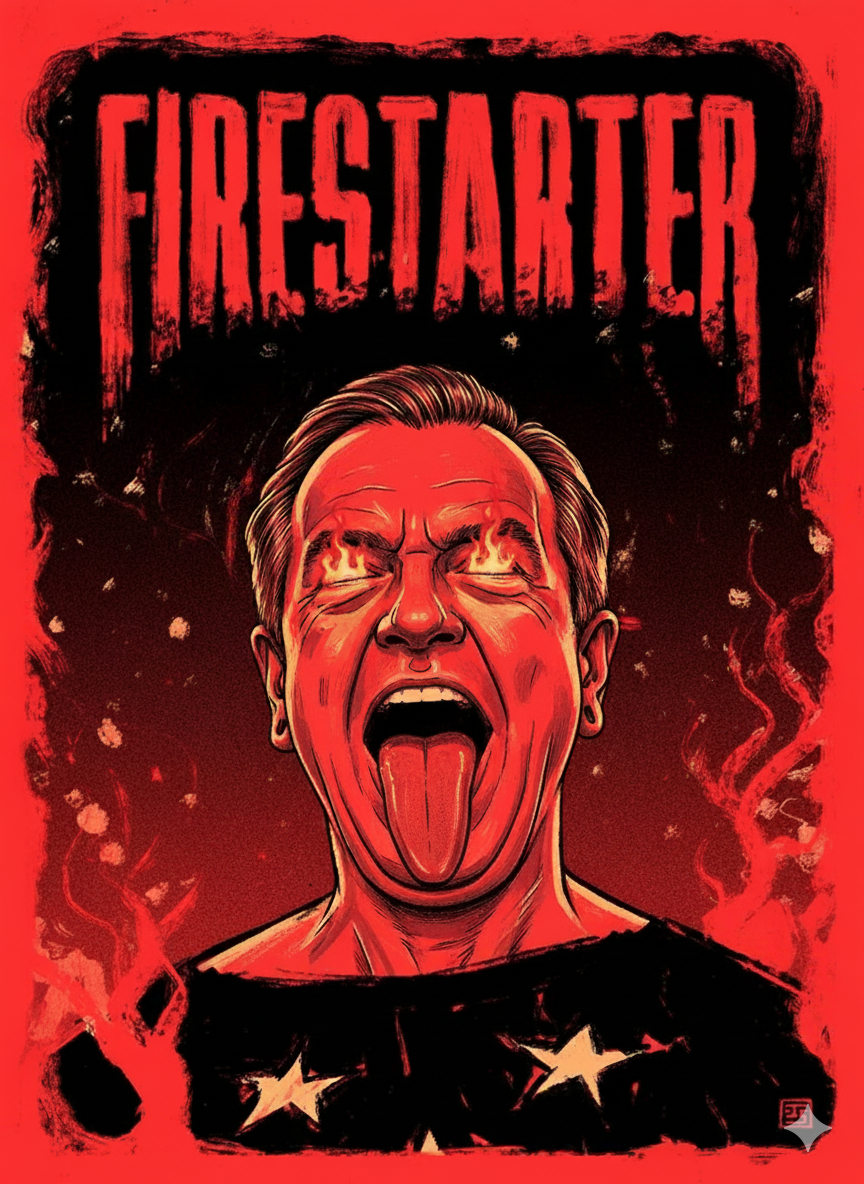
Nigel Farage has thrived as a political insurgent and would be useless as an incumbent of political office, like the turd that won’t flush. He has become a constant fixture in the feckless punditry of the media class, proffered to the disenfranchised and angry as a universal panacea for their grinding poverty and relentless exploitation. His is the politics of hate and eugenics dressed up in red, white, and blue.
But there really is hope.
For alongside the stench of stale ale, fags, and old roubles, there is the toxic whiff of yesterday’s news about him. Like your hate-filled racist uncle, he has overstayed his welcome, another Trump tribute act and just one repeat appearance too many from Aunty Beeb.
Nigel Farage embodies feelings of visceral disgust and a sense of national embarrassment. Drunk on attention, he refuses to leave the political stage, even as we grapple with a terrifying political reality. The weariness is palpable; the sense that those in charge are not just failing but speaking a different language has curdled into a desperation for anyone to dismantle the rotten structure. Recent polling even suggests this desperation could make him Prime Minister. The bloke from the pub, the uncle you avoid at family gatherings, could soon be the resident of Number 10. The fundamental problem with professional arsonists, of course, is that you should never, ever ask them to look after the matches or give them the keys to your house.
You have to hand it to him, the man knows his craft. For three decades, Farage has perfected the art of the political insurgent. He is a master diagnostician of national discontent, tapping into the veins of frustration over immigration, sovereignty, and a sneering elite with unerring accuracy. His victory with the Brexit campaign wasn’t a fluke; it was the culmination of a career spent turning apathy into anger, and anger into votes. He is a brilliant campaigner, a savvy media operator who can turn a cancelled bank account into a national crusade and command a stage with the practiced ease of a seasoned broadcaster. He provides a simple, satisfying release valve for a complex and paralysing pressure. He gives you someone to blame. And in a world that feels chaotic and nonsensical, that is a powerful, seductive gift.
But here’s the rub: the skills required to tear a house down are the polar opposite of those needed to build one. The insurgent’s armoury – the pint, the fag, the sharp soundbite – becomes a liability in the quiet corridors of power where detail, diplomacy, and diligence are the currency. This is a man who has serially quit every major leadership role he’s ever had, often vanishing in a puff of drama only to return when the spotlight beckoned once more. He has never run a government department, never managed a large-scale bureaucracy, and surrounded himself with a party whose own candidates have a history of scandal and incompetence. His entire career has been a protest against the establishment; he has no experience, and seemingly no interest, in the grinding, unglamorous work of actually being it.
Worse, his playbook for power is a recipe for national disaster. He championed Liz Truss’s catastrophic mini-budget, a policy that sent the markets into a tailspin, and seems keen to repeat the experiment. Analysts warn a Farage premiership could trigger a 20% collapse in the pound, with inflation and mortgage rates soaring into double digits. His signature policy, Brexit, is a project he now openly admits has failed, yet his solution is inevitably more of the same poison. That stench of stale ale and old roubles you mentioned isn’t just an aesthetic; it’s the smell of economic instability and diplomatic isolation. It’s the toxic whiff of a man still shouting the same old slogans as the world moves on, leaving us to live with the consequences.
So, what do we do? It’s easy to feel helpless, to simply ride the wave of outrage and despair. But that is exactly what this brand of politics wants. It thrives on our exhaustion. The real act of rebellion, the truly patriotic act, isn’t to find a louder strongman to shout back. It is to deny the outrage-merchants their fuel. It starts with a quiet, personal insurgency: curating your media diet with ruthless discipline, practising what you might call informational hygiene, and refusing to let your emotional state be dictated by the latest manufactured controversy.
And then you take that resilience outside. The antidote to the grand, empty spectacle of national politics is the tangible reality of local action. Find the most boring-sounding local committee you can – planning, parks, the parish council – and join it. Re-engage with the civic fabric of your community by talking to people. Build something. Fix something. This is the painstaking, vital work of democracy. It’s the levy that shores up the flood defences against the tide of populism. It is how we prove that real power doesn’t come from a bloke shouting in a television studio, but from the collective, determined effort of people who have decided, quietly and firmly, to take back control for themselves.
Like many writers in 2026, I use AI tools as part of my process, in this case Grok, Perplexity, Grammarly and Gemini, to help with research, brainstorming, exploration, and generating initial drafts and organising complex thoughts. However, this blog is not AI-generated content.
Every post is the result of my own research, lived experience, and extensive rewriting.
The final arguments, metaphors, and conclusions are mine alone. I disclose this because I believe the fight for human creativity begins with honesty about how we create.


 Quentin Budworth