In the US, online political clashes are often better understood as a battle of internet subcultures. Two major groups on the far-right, while frequently lumped together, are worlds apart: the traditional Christian nationalists and the nihilistic ‘black-pilled’ wing of the ‘groyper’ scene.
The simplest way to frame it is as the ‘builders’ versus the ‘burners’.
The builders—the Christian nationalists—are still trying to construct something. They have a vision for an explicitly Christian nation, founded on order, hierarchy, and a return to what they see as ‘proper’ social roles. Their strategy is institutional: win elections, pass laws, stack the courts, and capture the school boards. Their language centres on ‘restoration’ and ‘revival’. Even when their rhetoric gets apocalyptic, the end goal is to use state power to enforce a particular moral order.
The burners, however, are orbiting a completely different sun. This is a much younger, more terminally online crowd, full of streamers and internet personalities. Their worldview is steeped in the cynicism of incel forums, gamer culture, and a deeply ironic, ‘edgelord’ sense of humour.
The crucial distinction is their profound loss of faith in reform. The black pilled wing is utterly convinced that our institutions, our culture, and even people themselves are beyond saving. The ‘black pill’ is a metaphor for accepting a brutal ‘truth’: that decline is irreversible, making despair the only rational response. If nothing can be redeemed, the only creative act left is to tear it all down. This accelerationism operates less like a political programme and more like a social physics, deliberately pressing on every social fault line—from race to gender—just to see what breaks. It is, essentially, the worship of things falling apart.
The bizarre, cryptic memes are central because, for them, the style is the substance. The meme factory serves several functions at once.
It’s a fiercely effective recruitment tool. A darkly funny, high-contrast image travels much faster and wider than a dense policy document. It’s also wrapped in the Kevlar vest of irony, which offers plausible deniability; if you’re offended, they were ‘just joking’. Finally, it works to desensitise its audience. Shock is used like a muscle. The first time you see something awful, you flinch. By the hundredth time, an idea that was once unthinkable feels perfectly normal within the group. This is why their aesthetic is such a chaotic mash-up of cartoon frogs and nihilistic jokes. The underlying message is that nothing matters.
You can start to see the appeal for those who feel exiled from the traditional games of status—dating, university, a good career. It offers a cheap and easy form of belonging where attention is the only currency.
This helps explain why real-world incidents are often followed by posts loaded with strange symbols. The act itself is a performance for an online audience, where the primary aim is gaining in-group status by turning reality into a toxic, private joke.
This doesn’t make it harmless, not for a second. A politics that only wants to break things can still inspire catastrophe, because its only measure of success is destruction.
The antidote requires us to refuse the seductive pull of nihilism and call the black pill what it is: a permission slip for cruelty hiding behind a mask of sophistication. After that, it’s about doing the quiet, unglamorous work of building real meaning and belonging in our lives—in places where empty spectacle can’t compete.
When you get right down to it, Christian nationalism is a plan to rule; black pilled accelerationism is a plan to ruin. Once you grasp that polarity, the memes stop looking like mysterious runes and start looking like what they are: billboards for a politics of nothing.
Like many writers in 2026, I use AI tools as part of my process, in this case Grok, Perplexity, Grammarly and Gemini, to help with research, brainstorming, exploration, and generating initial drafts and organising complex thoughts. However, this blog is not AI-generated content.
Every post is the result of my own research, lived experience, and extensive rewriting.
The final arguments, metaphors, and conclusions are mine alone. I disclose this because I believe the fight for human creativity begins with honesty about how we create.
Like many writers in 2026, I use AI tools as part of my process, in this case Grok, Perplexity, Grammarly and Gemini, to help with research, brainstorming, exploration, and generating initial drafts and organising complex thoughts. However, this blog is not AI-generated content.
Every post is the result of my own research, lived experience, and extensive rewriting.
The final arguments, metaphors, and conclusions are mine alone. I disclose this because I believe the fight for human creativity begins with honesty about how we create.
Ever had that strange feeling? You mention needing a new garden fork in a message, and for the next week, every corner of the internet is suddenly waving one in your face. It’s a small thing, a bit of a joke, but it’s a sign of something much bigger, a sign that the digital world—a place of incredible creativity and connection—doesn’t quite feel like your own anymore.
The truth is, and let’s be authentic about it, we’ve struck a strange bargain. We’re not really the customers of these huge tech companies; in a funny sort of way, we’re the product. We leave a trail of digital breadcrumbs with every click and share, not realising they’re being gathered for someone else’s feast. Our digital lives are being used to train algorithms that are learning to anticipate our every move. It’s all a bit like we’re living in a house with glass walls, and we’ve forgotten who’s looking in or why. We’ve drifted into a new kind of system, a techno-feudalism, where a handful of companies own the infrastructure, write the rules we blithely agree to, and profit from the very essence of us.
This isn’t some far-off problem; it’s happening right here on our doorstep. Take Palantir, a US spy-tech firm now managing a massive platform of our NHS patient data. They’re also working with UK police forces, using their tech to build surveillance networks that can track everything from our movements to our political views. Even local councils are getting in on the act, with Coventry reviewing a half-a-million-pound deal with the firm after people, quite rightly, got worried. This is our data, our health records, our lives.
When you see how engineered the whole system is, you can’t help but ask: why aren’t we doing more to protect ourselves? Why do we have more rights down at the DVLA than we do online? Here in the UK, we have laws like the GDPR and the new Data (Use and Access) Act 2025, which sound good on paper. But in practice, they’re riddled with loopholes, and recent changes have actually made it easier for our data to be used without clear consent. Meanwhile, data brokers are trading our information with little oversight, creating risks that the government itself has acknowledged are a threat to our privacy and security.
It feels less like a mistake and more like the intended design.
This isn’t just about annoying ads. Algorithms are making life-changing decisions. In some English councils, AI tools have been found to downplay women’s health issues, baking gender bias right into social care. Imagine your own mother or sister’s health concerns being dismissed not by a doctor, but by a dispassionate algorithm that was never taught to listen properly. Amnesty International revealed last year how nearly three-quarters of our police forces are using “predictive” tech that is “supercharging racism” by targeting people based on biased postcode data. At the same time, police are rolling out more live facial recognition vans, treating everyone on the street like a potential suspect—a practice we know discriminates against people of colour. Even Sainsbury’s is testing it to stop shoplifters. This isn’t the kind, fair, and empathetic society we want to be building.
So, when things feel this big and overwhelming, it’s easy to feel a bit lost. But this is where we need to find that bit of steely grit. This is where we say, “Right, what’s next?”
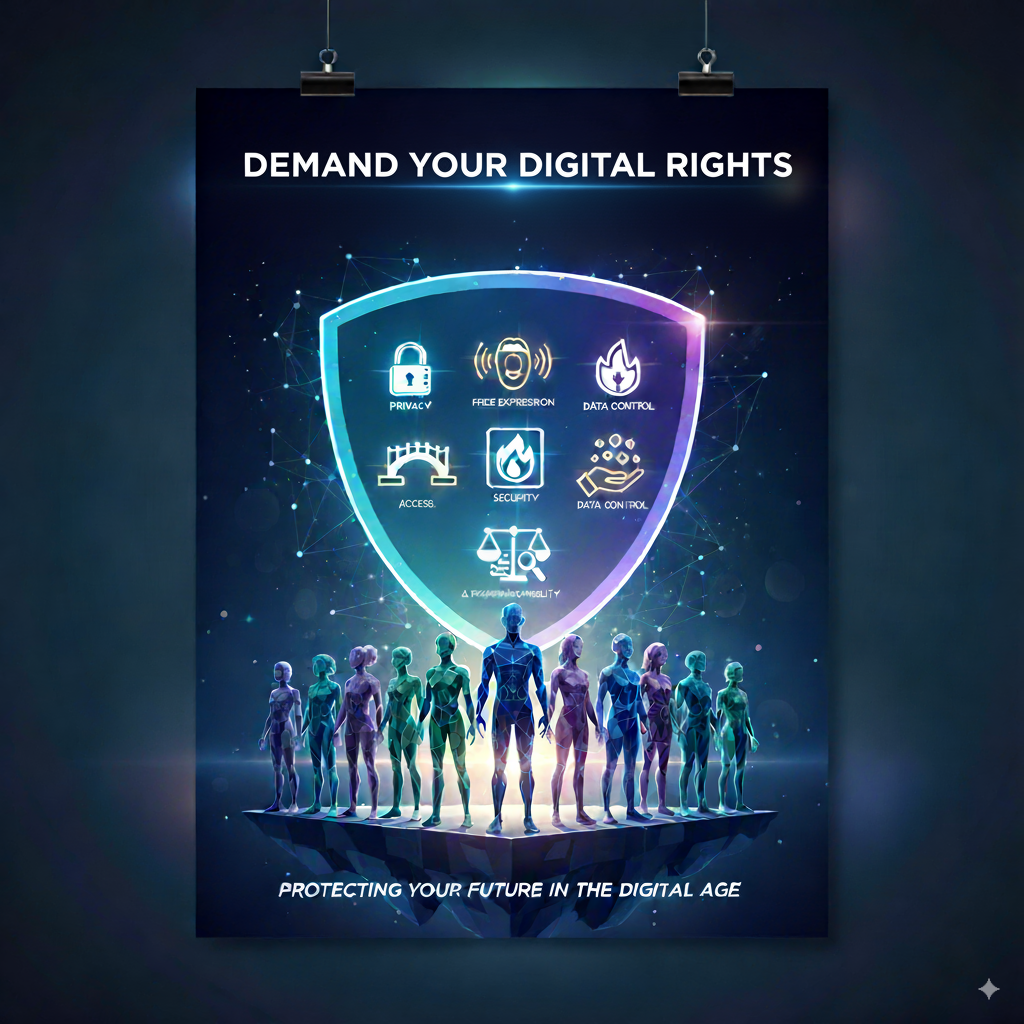
If awareness isn’t enough, what’s the one thing that could genuinely change the game? It’s a Digital Bill of Rights. Think of it not as some dry legal document, but as a firewall for our humanity. A clear, binding set of principles that puts people before profit.
So, if we were to sit down together and draft this charter, what would be our non-negotiables? What would we demand? It might look something like this:
The right to digital privacy. The right to exist online without being constantly tracked and profiled without our clear, ongoing, and revocable consent. Period.
The right to human judgment. If a machine makes a significant decision about you – such as your job or loan – you should always have the right to have a human review it. AI does not get the final say.
A ban on predictive policing. No more criminalising people based on their postcode or the colour of their skin. That’s not justice; it’s algorithmic segregation.
The right to anonymity and encryption. The freedom to be online without being unmasked. Encryption isn’t shady; in this world, it’s about survival.
The right to control and delete our data. To be able to see what’s held on us and get rid of it completely. No hidden menus, no 30-day waiting periods. Just gone.
Transparency for AI. If an algorithm is being used on you, its logic and the data it was trained on should be open to scrutiny. No more black boxes affecting our lives.
And we need to go further, making sure these rights protect everyone, especially those most often targeted. That means mandatory, public audits for bias in every major AI system. A ban on biometric surveillance in our public spaces. And the right for our communities to have a say in how their culture and data are used.
Once this becomes law, everything changes. Consent becomes real. Transparency becomes the norm. Power shifts.
Honestly, you can’t private-browse your way out of this. You can’t just tweak your settings and hope for the best. The only way forward is together. A Digital Bill of Rights isn’t just a policy document; it’s a collective statement. It’s a creative, hopeful project we can all be a part of. It’s us saying, with one voice: you don’t own us, and you don’t get to decide what our future looks like.
This is so much bigger than privacy. It’s about our sovereignty as human beings. The tech platforms have kept us isolated on purpose, distracted and fragmented. But when we stand together and demand consent, transparency, and the simple power to say no, that’s the moment everything shifts. That’s how real change begins – not with permission, but with a shared sense of purpose and a bit of good-humoured, resilient pressure. They built this techno-nightmare thinking no one would ever organise against it. Let’s show them they were wrong.
The time is now. With every new development, the window for action gets a little smaller. Let’s demand a Citizen’s Bill of Digital Rights and Protections from our MPs and support groups like Amnesty, Liberty, and the Open Rights Group. Let’s build a digital world that reflects the best of us: one that is creative, kind, and truly free.
Like many writers in 2026, I use AI tools as part of my process, in this case Grok, Perplexity, Grammarly and Gemini, to help with research, brainstorming, exploration, and generating initial drafts and organising complex thoughts. However, this blog is not AI-generated content.
Every post is the result of my own research, lived experience, and extensive rewriting.
The final arguments, metaphors, and conclusions are mine alone. I disclose this because I believe the fight for human creativity begins with honesty about how we create.
Like many writers in 2026, I use AI tools as part of my process, in this case Grok, Perplexity, Grammarly and Gemini, to help with research, brainstorming, exploration, and generating initial drafts and organising complex thoughts. However, this blog is not AI-generated content.
Every post is the result of my own research, lived experience, and extensive rewriting.
The final arguments, metaphors, and conclusions are mine alone. I disclose this because I believe the fight for human creativity begins with honesty about how we create.
Police use spyware from Israeli firm Cellebrite to hack phones. But does this powerful surveillance tool threaten our own national security?
It’s the modern detective’s dream: a skeleton key for any smartphone. When a case hinges on data locked inside a device, surveillance technology from companies like Israel’s Cellebrite offers a way in. British police forces are spending millions on these tools. But the very power that makes them so effective also makes them a profound threat to privacy, a tool for oppression, and a startling vulnerability at the heart of our national security.
This isn’t just about pulling a few incriminating texts. The technology performs a complete digital dissection of a person’s life, copying everything: every email, photo, video, and call log. It goes deeper, recovering deleted messages and digging into hidden files that track your location history. It can even reach into your cloud backups, downloading data you thought was stored safely away.
Your Life in a Police File
The implications for ordinary people are chilling. When police use these tools, they often perform a complete “data dump” of the device. Your intensely personal and entirely irrelevant data gets hoovered up right alongside any potential evidence. Victims of crime are often told to hand over their phones, unaware that their entire digital life could be scrutinised.
This practice erodes the trust between the public and the justice system. And with no transparent public record of how often these tools are used, we are left in the dark about whether this immense power is being used proportionately, or simply because it’s there.
A Ready-Made Tool for Tyrants
The story gets darker. This technology is not just used by police in democratic nations. The client list includes some of the world’s most repressive regimes. In Bahrain, it was used to prosecute a tortured activist. In Myanmar, it helped build the case against journalists investigating a massacre. Despite corporate assurances, these tools consistently end up in the hands of governments who use them to hunt down anyone who speaks out of line.
The technology’s sharpest edge is found in conflict zones. In Gaza, it has reportedly been used not as a tool for justice, but as an instrument of military intelligence. Reports describe the mass seizure of phones from Palestinians to map social networks, track movements, and inform targeting decisions. It is population control through technology.
Forged in Intelligence: The Unit 8200 Connection
You can’t understand this technology without understanding its origins. Cellebrite, in particular, is a product of Israel’s state intelligence machine, specifically the legendary cyber-warfare corps, Unit 8200. This unit serves as an incubator for Israel’s tech sector, and its veterans often move into senior roles at surveillance companies.
This isn’t a neutral tech company; it’s a strategic asset of the Israeli state. The revolving door between the military and the boardroom means its technology is born from a philosophy of state security, not just criminal justice.
“When a police force buys this tech, they aren’t just buying software; they’re importing a national security risk.”
An Agent in the Evidence Room
This is where the story comes home. When a British police force uses this tech, it may be inadvertently placing a foreign agent in its own evidence room. The shift to cloud-based software means data extracted in a London station could be processed on servers with ties to a foreign military. This fundamentally compromises our data sovereignty.
This hands a powerful lever of influence to another country. Access to the compromising data of a nation’s leaders, judges, or military officials is the kind of leverage that can quietly shape foreign policy. It’s a stark reminder that in the world of intelligence, there is often no such thing as a true friend, only interests.
The question for any democracy is stark. In the scramble for a tool to keep us safe, are we willing to trade a piece of our own sovereignty to get it?
Like many writers in 2026, I use AI tools as part of my process, in this case Grok, Perplexity, Grammarly and Gemini, to help with research, brainstorming, exploration, and generating initial drafts and organising complex thoughts. However, this blog is not AI-generated content.
Every post is the result of my own research, lived experience, and extensive rewriting.
The final arguments, metaphors, and conclusions are mine alone. I disclose this because I believe the fight for human creativity begins with honesty about how we create.
The AI on your phone isn’t just a helper. It’s a tool for corporate and state control that puts our democracy at risk.
I was surprised when my Android phone suddenly updated itself, and Gemini AI appeared on the front screen, inviting me to join the AI revolution happening worldwide.
Google, Apple, and Meta are locked in a high-stakes race to put a powerful AI assistant in your pocket. The promise is a life of seamless convenience. The price, however, may be the keys to your entire digital life, and the fallout threatens to stretch far beyond your personal data.
This isn’t merely my middle-aged luddite paranoia; widespread public anxiety has cast a sharp light on the trade-offs we are being asked to accept. This investigation will demonstrate how the fundamental design of modern AI, with its reliance on vast datasets and susceptibility to manipulation, creates a perfect storm. It not only exposes individuals to new forms of hacking and surveillance but also provides the tools for unprecedented corporate and government control, undermining the foundations of democratic society while empowering authoritarian regimes.
A Hacker’s New Playground
Let’s be clear about the immediate technical risk. Many sophisticated AI tasks are too complex for a phone to handle alone and require data to be sent to corporate cloud servers. This process can bypass the end-to-end encryption we have come to rely on, exposing our supposedly private data.
Worse still is the documented vulnerability known as “prompt injection.” This is a new and alarmingly simple form of hacking where malicious commands are hidden in webpages or even video subtitles. These prompts can trick an AI assistant into carrying out harmful actions, such as sending your passwords to a scammer. This technique effectively democratises hacking, and there is no foolproof solution.
The Foundations of Democracy Under Threat
This combination of data exposure and vulnerability creates a perfect storm for democratic systems. A healthy democracy relies on an informed public and trust in its institutions, both of which are directly threatened.
When AI can generate floods of convincing but entirely fake news or deepfake videos, it pollutes the information ecosystem. A 2023 article in the Journal of Democracy warned that this erosion of social trust weakens democratic accountability. The threat is real, with a 2024 Carnegie Endowment report detailing how AI enables malicious actors to disrupt elections with sophisticated, tailored propaganda.
At the same time, the dominance of a few tech giants creates a new form of unaccountable power. As these corporations become the gatekeepers of AI-driven information, they risk becoming a “hyper-technocracy,” shaping public opinion without any democratic oversight.
A Toolkit for the Modern Authoritarian
If AI presents a challenge to democracies, it is a powerful asset for authoritarian regimes. The tools that cause concern in open societies are ideal for surveillance and control. A 2023 Freedom House report noted that AI dramatically amplifies digital repression, making censorship faster and cheaper.
Regimes in China and Russia are already leveraging AI to produce sophisticated propaganda and control their populations. From automated censorship that suppresses dissent to the creation of fake online personas that push state-sponsored narratives, AI provides the ultimate toolkit for modern authoritarianism.
How to Take Back Control
A slide into this future is not inevitable. Practical solutions are available for those willing to make a conscious choice to protect their digital autonomy.
For private communication, established apps like Signal offer robust encryption and have resisted AI integration. For email services, Tuta Mail provides an AI-free alternative. For those wanting to use AI on their own terms, open-source tools like Jan.ai allow you to run models locally on your own computer.
Perhaps the most powerful step is to reconsider your operating system. On a PC, Linux Mint is a privacy-respecting alternative. For smartphones, GrapheneOS, a hardened version of Android, provides a significant shield against corporate data gathering.
The code has been written, and the devices are in our hands. The next battle will be fought not in the cloud, but in parliaments and regulatory bodies, where the rules for this new era have yet to be decided. The time for us, and our government, to act is now.
Like many writers in 2026, I use AI tools as part of my process, in this case Grok, Perplexity, Grammarly and Gemini, to help with research, brainstorming, exploration, and generating initial drafts and organising complex thoughts. However, this blog is not AI-generated content.
Every post is the result of my own research, lived experience, and extensive rewriting.
The final arguments, metaphors, and conclusions are mine alone. I disclose this because I believe the fight for human creativity begins with honesty about how we create.
There’s a growing sense that the whole capitalist project is running on fumes. For decades, it’s been a system built on one simple rule: endless growth. But what happens when it runs out of road? It has already consumed new lands, markets, and even the quiet personal spaces of our attention. Think of it like a shark that must constantly swim forward to breathe, and it has finally hit the wall of the aquarium. The frantic, desperate thrashing we’re seeing in our politics and society? That’s the crisis.
For the last forty-odd years, the dominant philosophy steering our world has been Neoliberalism. Stripped to its bare bones, it’s a simple creed: privatise anything that isn’t nailed down, deregulate in the name of ‘freedom’, and chase economic growth as if it were the only god worth worshipping. What has become chillingly clear is that the current lurch towards authoritarianism isn’t a strange detour or a bug in the system; it’s the next logical feature. Technofascism isn’t some bizarre alternative to neoliberalism; it is its terrifying, inevitable endgame. It is emerging as a ‘last-ditch effort’ to rescue a system in terminal crisis, and the price of that rescue is democracy itself.
Before you can build such a machine, you need a blueprint. The blueprint for this new form of control is a set of extreme ideas that’d be laughable if their proponents weren’t sitting on mountains of cash and power. At the heart of a gloomy-sounding gentlemen’s club of philosophies, which includes Neo-Reactionism (or NRx), the Dark Enlightenment, and Accelerationism, is a deep, abiding, and utterly sincere contempt for the very idea of liberal democracy. They see it as a messy, sentimental, and ‘incredibly inefficient’ relic, a ‘failed experiment’ that just gets in the way of what they consider real progress.
This isn’t just a passing grumble about politicians. It’s a root-and-branch rejection of the last few centuries of political thought. Their utopia is a society restructured as a hyper-efficient tech start-up, helmed by a god-like ‘CEO-autocrat’. This genius-leader, naturally drawn from their own ranks, would be free to enact his grand vision without being bothered by tedious things like elections or civil liberties. It’s an idea born of staggering arrogance, a belief that a handful of men from Silicon Valley are so uniquely brilliant that they alone should be calling the shots.
This thinking didn’t spring from nowhere. Its strange prophets include figures like Curtis Yarvin, a blogger who spins academic-sounding blather that tells billionaires their immense power is not just deserved but necessary. It’s a philosophy that offers a convenient, pseudo-intellectual justification for greed and bigotry, framing them as signs that one is ‘red-pilled’, an enlightened soul who can see through the progressive charade. This worldview leads directly to a crucial pillar of technofascism: the active rejection of history and expertise. This mindset is captured in the terrifying nonchalance of a Google executive who declared, ‘I don’t even know why we study history… what already happened doesn’t really matter.’ This isn’t just ignorance; it’s a strategic necessity. To build their imagined future, they must demolish the guardrails of historical lessons that warn us about fascism and teach us the value of human rights. They declare war on the ‘ivory tower’ and the ‘credentialed expert’ because a population that respects knowledge will see their project for the dangerous fantasy it is.
But an ideology, no matter how extreme, remains hot air until it is forged into something tangible. The next chapter of this story is about how that strange, anti-democratic philosophy was hammered into actual, working tools of control. A prime case study is the company Palantir. It is the perfect, chilling expression of its founder Peter Thiel’s desire to ‘unilaterally change the world without having to constantly convince people.’ This company did not accidentally fall into government work; it was built from its inception to serve the state. Its primary revenue streams are not ordinary consumers, but the most powerful and secretive parts of government: the CIA, the FBI, and the Department of Homeland Security. It embodies the new ‘public-private partnership’, where the lines between a corporation and the state’s security apparatus are erased entirely.
The product of this unholy union is a global software of oppression. At home, Palantir was awarded a contract to create a tool for ICE to ‘surveil, track, profile and ultimately deport undocumented migrants,’ turning high-minded talk of ‘inefficiency’ into the ugly reality of families being torn apart. This same machinery of control is then exported abroad, where the company becomes a key player in the new defence industrial base. Its systems are deployed by militaries around the globe, and nowhere is this more terrifyingly apparent than in conflicts like the one in Gaza. There, occupied territories have become a digital laboratory where AI-powered targeting systems, enabled by companies within this ecosystem, are battle-tested with brutal efficiency. The line between a software company and an arms dealer is not just blurred; it is erased. This is the ultimate expression of the public-private partnership: the privatisation of war itself, waged through algorithms and data streams, where conflict zones become the ultimate testing ground.
This architecture of control, however, is not just aimed outward at state-defined enemies; it is turned inward, against the foundational power of an organised populace: the rights of workers. Technofascism, like its historical predecessors, understands that to dominate a society, you must first break its collective spirit. There’s a chilling historical echo here; the very first groups targeted by the Nazis were communists, socialists, and trade unionists. They were targeted first because organised labour is a centre of collective power that stands in opposition to total authority. Today, this assault is cloaked in the language of ‘disruption’. The gig economy, championed by Silicon Valley, has systematically shattered stable employment in entire industries, replacing it with a precarious workforce of atomised individuals who are cheaper, more disposable, and crucially, harder to organise. This attack on present-day labour is just a prelude to their ultimate goal: the stated desire to ‘liberate capital from labor for good.’ The ‘mad rush’ to develop AI is, at its core, a rush to create a future where the vast majority of humanity is rendered economically irrelevant and therefore politically powerless.
The human cost of this vision is already being paid. A new global caste system is emerging, starkly illustrated by OpenAI. While AI researchers in California enjoy ‘million-dollar compensation packages,’ Kenyan data workers are paid a ‘few bucks an hour’ to be ‘deeply psychologically traumatised’ by the hateful content they must filter. This is not an oversight; it is a calculated feature of what can only be called the ‘logic of Empire’, a modern colonialism where the human cost is outsourced and rendered invisible. This calculated contempt for human dignity is mirrored in their treatment of the planet itself. The environmental price tag for the AI boom is staggering: data centres with the energy footprint of entire states, propped up by coal plants and methane turbines. A single Google facility in water-scarce Chile planned to use a thousand times more fresh water than the local community. This isn’t an unfortunate side effect; it’s the logical outcome of an ideology that sees the natural world as an obstacle to be conquered or a flawed planet to be escaped. The fantasy of colonising Mars is the ultimate expression of this: a lifeboat for billionaires, built on the premise that they have the right to destroy our only home in the name of their own ‘progress’.
Having built this formidable corporate engine, the final, crucial act is to seize the levers of political power itself. While it is tempting to see this as the work of one particular political tribe, embodied by a figure like Donald Trump acting as a ‘figurehead’ who normalises the unthinkable, the reality is now far more insidious. The ideology has become so pervasive that it has captured the entire political establishment.
Consider this: after years of opposing Tory-led Freeports, Keir Starmer’s Labour government announces the creation of ‘AI Growth Zones’—digital versions of the same deregulated havens, designed explicitly for Big Tech. The project has become bipartisan. The state’s role is no longer to regulate these powerful entities, but to actively carve out legal exceptions for them. This move is mirrored on the global stage, where both the UK and US refuse to sign an EU-led AI safety treaty. The reasoning offered is a masterclass in technofascist rhetoric. US Vice President JD Vance, a direct protégé of Peter Thiel, warns that regulation could “kill a transformative industry,” echoing the Silicon Valley line that democracy is a drag on innovation. Meanwhile, the UK spokesperson deflects, citing concerns over “national security,” the classic justification for bypassing democratic oversight to protect the interests of the state and its corporate security partners.
This quiet, administrative capture of the state is, in many ways, more dangerous than a loud revolution. It doesn’t require a strongman; it can be implemented by polished, ‘sensible’ leaders who present it as pragmatic and inevitable. The strategy for taking power is no longer just about a chaotic ‘flood the zone with shit’ campaign; it’s also about policy papers, bipartisan agreements, and the slow, methodical erosion of regulatory power.
This is where the abstract horror becomes horrifyingly, tangibly real. The tools built by Palantir are actively used to facilitate the ‘cruel deportations’ of real people, a process that is only set to accelerate now that governments are creating bespoke legal zones for such technology. The AI systems built on the backs of traumatised workers are poised to eliminate the jobs of artists and writers. The political chaos deliberately sown online spills out into real-world violence and division. This is the strategy in action, where the combination of extremist ideology, corporate power, and a captured political class results in devastating human consequences.
When you line it all up, the narrative is stark and clear. First, you have the strange, elitist philosophy, born of ego and a deep-seated contempt for ordinary people. This ideology then builds the corporate weapons to enforce its vision. And finally, these weapons are handed to a political class, across the spectrum, to dismantle democracy from the inside. This entire project is fuelled by a desperate attempt to keep the wheels on a capitalist system that has run out of options and is now cannibalising its own host society to survive.
And here’s the kicker, the final, bitter irony that we must sit with. An ideology that built its brand by screaming from the rooftops about ‘freedom’, individualism, and the power of the ‘free market’ has, in the end, produced the most sophisticated and all-encompassing tools of control and oppression humanity has ever seen.
It’s a grim picture, but there are no two ways about it. But this is precisely where our own values of resilience, empathy, and grounded and courageous optimism must come into play. The first, most crucial act of resistance is simply to see this process clearly, to understand it for what it is. to engage in what the ancient Greeks called an apocalypse, not an end-of-the-world event but a lifting of the veil, a revelation.
Seeing the game is the first step to refusing to play it, especially now that all the major political teams are on the same side. It’s the moment we can say, ‘No, thank you.’ It’s the moment we choose to slow down, to log off from their manufactured chaos, and to reconnect with the real, tangible world around us. It’s the choice to value the very things their ideology seeks to crush: kindness, community, creativity, and the simple, profound magic of human connection. Facing this reality takes courage, but doesn’t have to lead to despair. It can be the catalyst that reminds us what is truly worth fighting for. And that, in itself, in a world of bipartisan consensus, is the most powerful and hopeful place to start.
Like many writers in 2026, I use AI tools as part of my process, in this case Grok, Perplexity, Grammarly and Gemini, to help with research, brainstorming, exploration, and generating initial drafts and organising complex thoughts. However, this blog is not AI-generated content.
Every post is the result of my own research, lived experience, and extensive rewriting.
The final arguments, metaphors, and conclusions are mine alone. I disclose this because I believe the fight for human creativity begins with honesty about how we create.
It is Punch and Judy on the world stage, a performance designed to distract, confuse, and entertain. We get so caught up in the political drama that we miss what is happening behind the curtain. The political theorist Noam Chomsky has warned of this for decades, calling it the “illusion of debate”, an enchanting spectacle where we are encouraged to argue, heckle, and voice an outraged opinion, but only about things that don’t truly matter.
Chomsky put it bluntly: “The smart way to keep people passive and obedient is to strictly limit the spectrum of acceptable opinion, but allow lively debate within that spectrum.” We are led into a room and told we can rearrange the furniture as much as we like, but we must never think to knock down the walls. This keeps us feeling engaged while the fundamental systems that shape our lives remain unchallenged.
The high-profile feud between Donald Trump and Elon Musk is a perfect modern case study. The rolling news coverage presents a spectacular public blow-up, with Trump threatening to cut Musk’s multi-billion-dollar government contracts and Musk firing back with personal insults. It feels dramatic and significant.
But while we are glued to our screens, watching the meme wars unfold on social media, we miss the real story: both men are beneficiaries and proponents of the same system. Their public theatre distracts from their shared interest in maintaining corporate power. Trump’s landmark 2017 Tax Cuts and Jobs Act slashed the corporate tax rate from 35% to 21%. Meanwhile, Musk’s companies, such as SpaceX and Tesla, have raked billions from government contracts and subsidies, benefiting from policies that were advanced during the Trump administration and beyond. Despite the public spats, their economic interests align in opposing higher taxes on the wealthy and promoting deregulation.
This is the illusion of debate in action. While the media profits from the drama, critical policy decisions are made in the shadows. Investigations into corporate malpractice are quietly halted, labour laws are weakened, and environmental regulations are rolled back. The spectacle keeps the public divided and misinformed, undermining democratic accountability and preventing any unified challenge to a status quo that overwhelmingly favours elite interests.
This tactic is not new. From the Reagan-era tax cuts sold as “trickle-down economics” to the Clinton-era financial deregulation that paved the way for the 2008 crash, political theatre has long been used to divert public attention while corporate agendas advance.
So, what can we do? The first step is to recognise the performance for what it is. We must learn to ask better questions: not “Whose side are you on?” but “Who benefits from this entire system?“
Secondly, we must actively seek out diverse sources of information, particularly independent journalism that is not beholden to corporate advertisers or political factions. This allows us to see the whole picture, not just the carefully framed sliver presented to us.
Finally, we need to engage with politics more meaningfully. This means focusing on policy, not personality. It means getting involved locally, where our voices have a tangible impact. History shows that it is possible when people come together to demand systemic change. Breaking the spell of the illusion is not just an act of intellectual curiosity but a vital act of democratic self-defence.
Additional Information and Resources:
Table: Summary of Hidden Agendas and Mechanisms:
Hidden Agenda
Description
Mechanism
Maintaining Corporate Control
Ensure corporate-friendly policies are implemented without opposition.
Divert attention from lobbying and policy changes.
Protecting Elite Interests
Protect wealth and power of elites, including billionaires.
Keep public divided and entertained, preventing unified action.
Manipulating Public Perception
Shape opinion in favor of status quo or corporate agendas.
Frame issues as personal conflicts, influencing priorities.
Undermining Democratic Accountability
Reduce accountability of officials and corporate leaders.
Distract from transparency demands, focusing on spectacle.
Generating Media Profits
Increase viewership and revenue for media companies.
Amplify sensational stories for higher ratings and engagement.
Like many writers in 2026, I use AI tools as part of my process, in this case Grok, Perplexity, Grammarly and Gemini, to help with research, brainstorming, exploration, and generating initial drafts and organising complex thoughts. However, this blog is not AI-generated content.
Every post is the result of my own research, lived experience, and extensive rewriting.
The final arguments, metaphors, and conclusions are mine alone. I disclose this because I believe the fight for human creativity begins with honesty about how we create.
Zuckerberg’s Digital Fiefdom: It’s Time to Dismantle His Machine
Listen up, this isn’t just a tale of some tech mogul’s rise and fall. This is about Mark Zuckerberg, a shape-shifting opportunist exploiting us for over a decade, turning our friendships, news, and thoughts into his cash cow. He’s built a mind-numbing machine that’s got billions of us hooked, and now he’s panicking because the Federal Trade Commission (FTC) has him in its sights. They’re calling out his illegal monopoly, and they’re spot on. But don’t hold your breath for justice—Zuckerberg’s already cosying up to Trump, trying to dodge the axe. Let’s tear the mask off this digital schemer and expose what he’s done to us.
How Zuckerberg Betrayed Us
Zuckerberg didn’t just create Facebook; he weaponised it. Back then, it was a nifty site to connect with mates. But don’t be fooled—that “hot-or-not” Harvard gimmick was the start of his info-grabbing scheme. By 2011, he’d cornered 95% of the social media market, turning your likes, chats, and family photos into a goldmine. His trick? Connect us, harvest our lives, and flog us to advertisers like livestock. That’s Meta’s “secret sauce”—a surveillance machine so cunning it makes Orwell’s Big Brother look like a nosy neighbour. Zuckerberg’s wealth soared to £13 billion, then £142 billion, all while he fed us the lie that it’s “less commercial” to see your friend’s scarf purchase than a high-street ad. Utter nonsense.
Then smartphones arrived, and his fiefdom wobbled. The iPhone put the internet in our pockets, and Facebook’s clunky app was a mess compared to nimble upstarts. Instagram was outpacing him, growing like wildfire with its 100 million users. Did Zuckerberg innovate? Not a chance. He bought Instagram for £1 billion, a desperate move to crush the competition. Then he splashed £19 billion on WhatsApp, a privacy-first app that could’ve been his undoing. Why? Because WhatsApp didn’t hoover up personal info like his creepy platform. It charged a quid a year and let you chat without being bombarded by ads. But once Zuckerberg got hold of it, he gutted WhatsApp’s privacy promises, driving its founders to walk away from over £770 million in stock options rather than play his grubby game.
The FTC’s Battle and Zuckerberg’s Slippery Tactics
The FTC, led by the formidable Lina Khan until recently, is finally holding Zuckerberg to account. They say Meta’s a monopoly, built on smothering rivals like Instagram and WhatsApp to keep us trapped in his digital fortress. This isn’t just about market share—it’s about how Zuckerberg’s machine controls what you see, what you think, who owns your attention. Khan’s team wants to break Meta apart, unwind those acquisitions, and give us a shot at platforms that don’t treat us like personal info grist. They’ve got Zuckerberg’s own emails, his shady motives laid bare, a smoking gun screaming, “I bought my way to power!” Case closed, right? Wrong. The courts have been hobbled, making monopoly cases more challenging than scaling Snowdon in sandals. Meta’s got a legion of lawyers—ten for every one the FTC can muster. And they’re playing dirty, claiming Khan’s too biased to judge them, as if they’re the victims. Spare us the sob story.
Zuckerberg’s not just fighting in court; he’s playing politics like a seasoned operator. He’s sidling up to Trump, dining at Mar-a-Lago, tossing a million quid at the inauguration fund, even sticking a Trump ally on his board. Why? To wriggle out of this lawsuit. The FTC demanded £23 billion to settle; Trump’s team cut it to £14 billion. Meta’s counter? A measly £770 million—loose change for a company raking in £127 billion a year. This is Zuckerberg’s game plan: buy your way out, consequences be damned. He’s been at it since he hobnobbed with Obama, then staged a fake apology tour after mucking up the 2016 election. Now he’s cheering for Trump, calling him “badass” to save his own neck. It’s not politics; it’s survival for a man who knows his fiefdom’s built on sand.
Why You Should Be Livid
This isn’t just about Zuckerberg’s billions—it’s about you. Every notification, every endless scroll, every ad that knows your deepest fears? That’s Meta mining your life like it’s an oil field. Each like you give trains his algorithms to keep you hooked longer. If the FTC wins, we might get platforms that don’t treat privacy like a bad joke. Picture social networks that compete on connection, not exploitation—ones that don’t leave you scrolling like a zombie at 2 a.m. But if Zuckerberg gets his way, we’re stuck in his digital cage, where every click feeds his machine. He’s already betting on the metaverse, a virtual prison where you strap on a headset and let him flog your eyeballs to advertisers. It’s a £7.7 billion flop, but he’s doubling down, dreaming of AI mates and holographic colleagues while we drown in his data quagmire.
Zuckerberg’s not the only villain—courts and politicians, too spineless or bought, prop up his game. The system’s rigged, letting him squash innovators before they start. If Meta gets carved up, it’s a crack in Big Tech’s iron grip. New platforms could rise, ones that don’t see you as a data cow to be milked. But if Zuckerberg slinks away, he’ll keep ruling our digital lives, and the next generation of creators will be crushed.
Time to Fight Back
So, what do we do? First, get angry. This isn’t just a lawsuit; it’s a battle for your mind, time, and freedom. Zuckerberg’s machine thrives because we keep feeding it. Stop scrolling mindlessly. Question every ad, every nudge. Ditch Meta’s apps for a month—try BlueSky, Signal or Mastodon instead. Seek out platforms that don’t treat you like a product—they’re out there, struggling to survive. Spread the word about this case because the more we see through Zuckerberg’s charade, the harder it is for him to hide. The FTC’s fighting, but they’re outgunned. We’re not. Share this rage, this truth, and ensure the following social network isn’t another Zuckerberg fantasy. Let’s tear his machine down, one conscious choice at a time.




 Quentin Budworth