
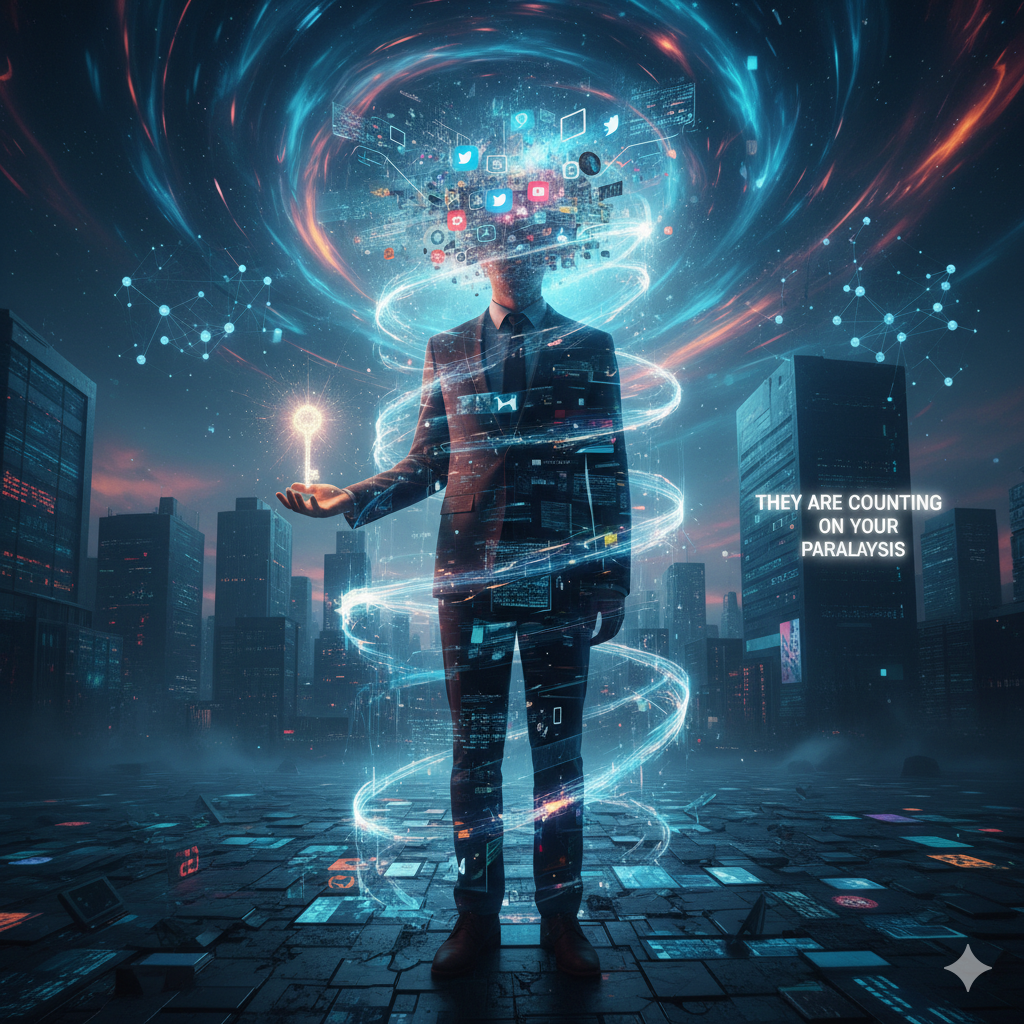
Modern authoritarianism has evolved. No longer solely reliant on the brute force of the 20th century, a new model of control has emerged: informational autocracy. This contemporary form of rule prioritises the sophisticated management of information flows over overt repression, manufacturing legitimacy by curating a reality where the regime is competent and opposition is illegitimate. While these autocrats maintain the façade of democracy through managed elections and hollowed-out institutions, their true power lies in dominating the narrative. In this digital age, social media platforms have become the principal arena and accelerator for this strategy, fundamentally transforming the complex relationship between the state, a knowledgeable “informed elite,” and the general populace. Social media acts as both a tool of co-optation and a vector for chaos, enabling autocrats to silence dissent while exporting tactics that actively erode democratic foundations worldwide.
At the heart of informational autocracy lies the strategic management of the “informed elite”—a segment of society comprising intellectuals, journalists, and professionals who possess the critical capacity to recognise and expose the regime’s flaws. Traditionally, this group poses the greatest threat to authoritarian stability, and social media presents a dual-edged sword for their neutralisation. On one edge, platforms like X (formerly Twitter), Facebook, and WeChat serve as tools for surveillance and control, allowing regimes to monitor the elite’s online activities, identify dissenters for targeted repression, and deploy subtle censorship through algorithmic demotion or shadow-banning. On the other, these same platforms are used for co-optation, recruiting influential figures to amplify state-approved narratives and lending a veneer of credibility to propaganda. In Turkey and Hungary, for instance, allied influencers and troll farms are leveraged to dominate online discourse, effectively turning a portion of the informed elite into digital mouthpieces for the state.
This capacity for control, however, is not absolute. The democratising nature of social media simultaneously threatens to disrupt the informational asymmetry that autocrats depend on. By allowing information to bypass state-controlled media, these platforms can potentially expand the informed elite, making it too large to co-opt or silence entirely. This forces regimes to intensify their grip on the broader information ecosystem, often through outright media monopolisation. This tension reveals the core paradox for modern authoritarians: the very platforms that offer unprecedented control also carry the seeds of their potential undoing. They fracture the elite’s traditional role as gatekeepers of information while simultaneously empowering grassroots dissent.
The very architecture of social media is uniquely suited to advancing the goals of informational autocracy. Platforms’ business models, predicated on maximising engagement, inadvertently favour the sensational, divisive, and emotionally charged content on which autocrats thrive. Algorithms designed for virality rather than veracity create echo chambers that reinforce regime propaganda and shield citizens from dissenting views. This allows rulers to “flood the zone” with disinformation, blurring the lines between fact and fiction until the public becomes cynical and disengaged. False political narratives, as studies have shown, spread significantly faster than truth, creating a “post-truth” environment where objective reality is secondary to partisan identity. This systematic degradation of trust in institutions—from the media to the electoral process—is not merely a byproduct of social media; it is a central objective of informational autocracy, and platforms provide the most efficient means to achieve it.
Perhaps most insidiously, the tactics of informational autocracy are no longer confined to authoritarian states. Social media has created a borderless information environment where these strategies are exported globally, seeping into and poisoning democratic societies. Autocrats have learned to weaponise the very freedoms that define democracies, using the openness of platforms to interfere in elections, amplify social divisions, and discredit liberal values as chaotic and weak. State-backed actors from Russia and China have perfected the art of cross-border disinformation, creating what can be seen as a “disinfo axis” that coordinates to undermine democratic solidarity on the world stage. In response, threatened democracies may find themselves adopting autocratic tools—such as increased censorship or surveillance—to combat these hybrid threats, risking an erosion of the very principles they seek to protect. This global spillover normalises autocratic practices and accelerates a worldwide trend of democratic backsliding.
In conclusion, informational autocracy represents a pernicious and adaptable evolution of authoritarian rule, and social media serves as its central nervous system. These platforms have revolutionised the autocrat’s toolkit, enabling a subtle yet pervasive form of control built on narrative dominance rather than physical coercion. By transforming the role of the informed elite into a dynamic contest of control and resistance, and by leveraging algorithms that prioritise engagement over truth, social media directly fuels the erosion of public trust and institutional legitimacy. This model is no longer a distant threat but a clear and present danger to established democracies, which now face an onslaught of digitally-native autocratic tactics designed to turn their own open systems against them. The struggle for the future of democracy is therefore inextricably linked to the battle for the digital public square, demanding a new focus on platform accountability, digital literacy, and the cultivation of an “info hygiene” resilient enough to withstand this slow-acting poison.
Like many writers in 2026, I use AI tools as part of my process, in this case Grok, Perplexity, Grammarly and Gemini, to help with research, brainstorming, exploration, and generating initial drafts and organising complex thoughts. However, this blog is not AI-generated content.
Every post is the result of my own research, lived experience, and extensive rewriting.
The final arguments, metaphors, and conclusions are mine alone. I disclose this because I believe the fight for human creativity begins with honesty about how we create.


 Quentin Budworth