Tag Archives: #socialchange

The Sleep of Reason: Why Goya’s Monsters are Winning in 2026

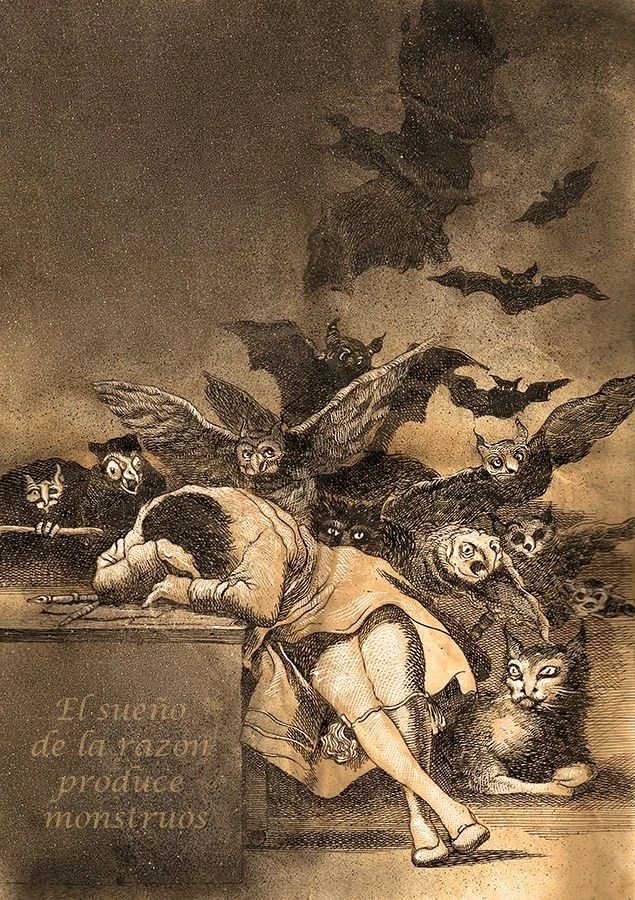
In Francisco Goya’s 1799 etching, The Sleep of Reason Produces Monsters, the artist is not merely napping. He has collapsed. His tools, the pens and paper of the Enlightenment, lie abandoned on the desk. Behind him, a swarm of owls and bats emerges from the blackness.

Goya’s Los Caprichos served as a warning to Spanish society, blinded by superstition and corruption. But today, the etching feels like a live-stream of the 2026 news cycle.

When reason sleeps, we don’t just dream of monsters. We build them.

The New Bestiary: Algorithms and Echoes

In the post-truth era, the “monsters” are digital. They are the algorithms that prioritise cortisol over comprehension.

According to the 2025 Digital News Report, we have reached a tipping point: 47% of the global population now identifies national politicians and “influencers” as the primary architects of disinformation. Reason hasn’t just faltered; it has been outsourced to partisan actors who benefit from its absence.

The Arendtian Nightmare

The political philosopher Hannah Arendt understood that the goal of total deception is not to make people believe a lie. It is intended to ensure that they can no longer distinguish between truth and falsehood.

In her 1967 essay Truth and Politics, Arendt warned that factual truth is “manoeuvred out of the world” by those in power. We see this today in the “defactualisation” of our economy. Despite rising consumer prices and growing unemployment, a barrage of “official” narratives in 2025 and 2026 has attempted to frame the economy as flawless. As Arendt predicted, when the public is subjected to constant, conflicting falsehoods, they don’t become informed—they become cynical and paralysed.

The Outrage Addiction

Why do we let the monsters in? Because they feel good.

Neuroscience tells us that outrage is a biological reward. A landmark study by Dominique de Quervain showed that the act of “punishing” a perceived villain lights up the dorsal striatum—the brain’s pleasure centre.

Social media is essentially a delivery system for this chemical hit. We are trapped in a cycle in which we conflate “online fury” with “social change.” This outrage functions as a smokescreen: while we argue over individual “villains” on our feeds, the structural monsters: inequality, surveillance, and capture – continue their work undisturbed.

The Architecture of the 1%

While the public is distracted by the digital swarm, wealth has been consolidated into a fortress. In 2026, the global wealth gap is no longer a gap; it is a chasm.

  • The Fortune: Billionaire wealth hit $18.3 trillion this year, an 81% increase since 2020.
  • The Control: The top 1% now own 37% of global assets, holding eighteen times the wealth of the bottom 50% combined.

This concentration of capital is the ultimate “monster.” It allows a tiny elite—who are 4,000 times more likely to hold political office than the average person—to dictate the boundaries of reality.

Cognitive Atrophy: The AI Trap

Our most vital tool for resistance, the human mind, is being blunted. A 2025 MIT study confirmed that heavy reliance on Large Language Models (LLMs) for critical thinking tasks correlates with weakened neural connectivity and a “doom loop” of cognitive dependency.

As the Brookings Institution warned in early 2026, we are witnessing a “cognitive atrophy.” If we offload our judgment to machines owned by the 1%, we lose the very faculty required to recognise the monsters in the first place.

Case Study: The Epstein Files and Systemic Silence

The release of 3 million pages of Epstein documents in January 2026 should have been a moment of total reckoning. With 300 “politically exposed persons” implicated—from British peers to European heads of state, the scale of the rot is undeniable.

Yet, the reaction has been a repeat of Goya’s etching. We focus on the “monsters” (the names in the files) while ignoring the “sleep” (the legal impunity and wealth-purchased silence) that enabled their existence. Epstein was not a glitch in the system; he was a feature of it.

Waking the Artist

Goya’s etching ends with a caption: “Imagination abandoned by reason produces impossible monsters; united with her, she is the mother of the arts and the source of their wonders.”

To wake up in 2026 requires more than “fact-checking.” It requires a reclamation of our tools:

  1. Cognitive Sovereignty: Limit the AI-driven “doom loop” and reclaim the capacity for independent analysis.
  2. Structural Sight: Stop chasing the “bats and owls” of individual outrage and look at the “desk”—the economic and political structures that house them.
  3. Institutional Integrity: Support the few remaining impartial bodies capable of holding power to account.

The monsters only vanish when the artist wakes up. It is time to pick up the tools.


Key References

How To Beat Reform

Core Strategic Principle: Diagnosis Before Prescription

Think of the 1970s and you think of flared trousers and Abba. You probably don’t think of Nazi salutes on British streets.

But for a time, the far-right National Front (NF) was a terrifying force in UK politics. Its skinhead gangs terrorised immigrant communities. Its leaders were open Hitler admirers. And in the 1977 elections, over 200,000 people voted for them.

Then, they were crushed. Not in a war, but by a brilliant, gritty campaign that united punk rockers, grandparents, trade unions and communities. Today, as a new wave of populism gains traction, the lessons from that victory are not just history – they’re a handbook.

Here’s how it was done, and how it applies now.

Lesson 1: Stop Debating, Start Disrupting

The anti-fascists of the ’70s knew a crucial truth: you can’t reason someone out of a position they weren’t reasoned into. So they didn’t try. Instead, their strategy was simple: make it impossible for the NF to function.

They physically blocked their marches. They packed their meetings and shouted them down. The goal wasn’t to win an argument; it was to create such a logistical nightmare that the authorities were forced to ban events and the Nazis were too ashamed to show their faces.

The Modern Application: Today, the town hall meeting has been replaced by the social media algorithm. The tactic of disruption isn’t just about physical blocking—which can backfire against a legal party—but about a more sophisticated, multi-pronged assault. This means flooding the digital space with compelling counter-content, using ‘pre-bunking’ techniques to inoculate the public against predictable manipulation, and actively ‘de-branding’ their language by refusing to parrot loaded terms. Instead of “stop the boats,” the debate becomes about “fixing the asylum system.” The goal remains the same: to deny their narrative the clean air it needs to breathe.

Lesson 2: Expose the Core, Not Just the Policies

The NF tried to hide its Nazi core behind a veneer of ‘respectable’ racism. Anti-fascists ripped this mask off. They circulated photos of leader John Tyndall in his not-at-all-a-Nazi-uniform and highlighted his speeches praising Hitler. The result? The more moderate followers fled, and the party splintered. The label ‘Nazi’ stuck because the evidence was overwhelming.

The Modern Application: This isn’t about slapping the ‘fascist’ label on every opponent. It’s about rigorous exposure. Who endorses this party? What do their policies logically lead to? When a candidate is found to have made extremist statements, the question to the leadership is simple: “Do you condone this? If not, what are you doing about it?” Force them to either repudiate their fringe or be defined by it. The battle is to expose the underlying narrative of national humiliation and purging, no matter how sanitised the language.

Lesson 3: Apply Institutional and Economic Friction

Beyond the battle of ideas lies the less visible but equally critical war of institutional accountability. The 1970s activists understood that pressure had to be applied at every level. When the Hackney Gazette ran an NF advert, its staff went on strike.

The Modern Application: The contemporary equivalent is wielding strategic economic and legal pressure. This means holding corporate donors publicly accountable, supporting rigorous challenges to potential campaign spending breaches, and demanding that media platforms couple any coverage with immediate, contextual fact-checking. The objective is to create friction—to make supporting or enabling populism a professionally and reputationally costly endeavour. This isn’t about silencing opposition, but about enforcing the rules and standards that populists seek to erode, ensuring demagoguery carries a tangible price.

Lesson 4: Out-Create Them. Make Hope Go Viral.

This was the masterstroke. While some groups fought in the streets, the Anti-Nazi League and Rock Against Racism (RAR) fought for the culture. They realised that to win over a generation, you couldn’t just be against something; you had to be for something better.

RAR staged legendary gigs that paired white punk bands like The Clash with Black reggae acts. Their 1978 carnival in London attracted 100,000 people—a joyful, defiant celebration that made the NF look like the miserable, hate-fuelled sect they were.

“This ain’t no fucking Woodstock. This is the Carnival against the Nazis!” – Red Saunders, RAR co-founder

The Modern Application: This is the most critical lesson. Populism feeds on pessimism and cultural despair. The antidote is to build a more compelling, positive, and inclusive vision. Where is the modern equivalent of RAR? It’s about supporting creators, artists, and community initiatives that showcase a confident, modern Britain. It’s about telling stories of successful integration and shared future, making ‘hope’ more viral than ‘fear’.

Lesson 5: Protect Your Own. Community is Armour.

When the state failed to protect them, targeted communities organised their own defence. The Southall Youth Movement and others made their neighbourhoods ‘no-go zones’ for racists, patrolling streets and confronting threats directly. This wasn’t just about physical safety; it was about building unbreakable social and political resilience.

“What did we  share with the white left? We learned from them   as well. We shared the vision of a new world,  our world, a world in which we were all equal,   a fairer world.” – Tariq Mahmood, activist

The Modern Application: The threats today are often more digital and psychological than physical, but the principle is the same. This means strengthening local community bonds, supporting organisations that monitor and combat hate crime, and building robust support networks. Critically, this work must be underpinned by a ‘marathon, not a sprint’ mentality. The defeat of the National Front was not the work of a single election cycle but a sustained, multi-year effort. The modern challenge is to build resilient, long-term infrastructure—’the bakery’—that can withstand populist waves by addressing the underlying grievances of isolation and economic despair they exploit.

The Uncomfortable Truth for Today

The crucial difference is that Reform UK is not the National Front. It is a populist party, not a fascist paramilitary one. Applying the 1970s playbook isn’t about mindlessly copying tactics; it’s about intelligently adapting the principles.

The battle against the NF was won by a coalition that understood this was a war fought on multiple fronts simultaneously. It required the raw energy of street-level disruption, the sharp wit of cultural creation, the shrewdness of political exposure, and the patient, grinding work of institutional and legal challenge.

To effectively challenge modern populism demands the same holistic courage. It is not enough to out-create them online if their economic enablers face no consequences. It is not enough to win a legal battle if the cultural narrative of grievance remains unchallenged. The lesson of the 1970s is that victory comes not from a single masterstroke, but from the relentless, coordinated application of pressure everywhere it counts. The question is whether we can build a movement with the strategic depth to fight on all those fronts at once.