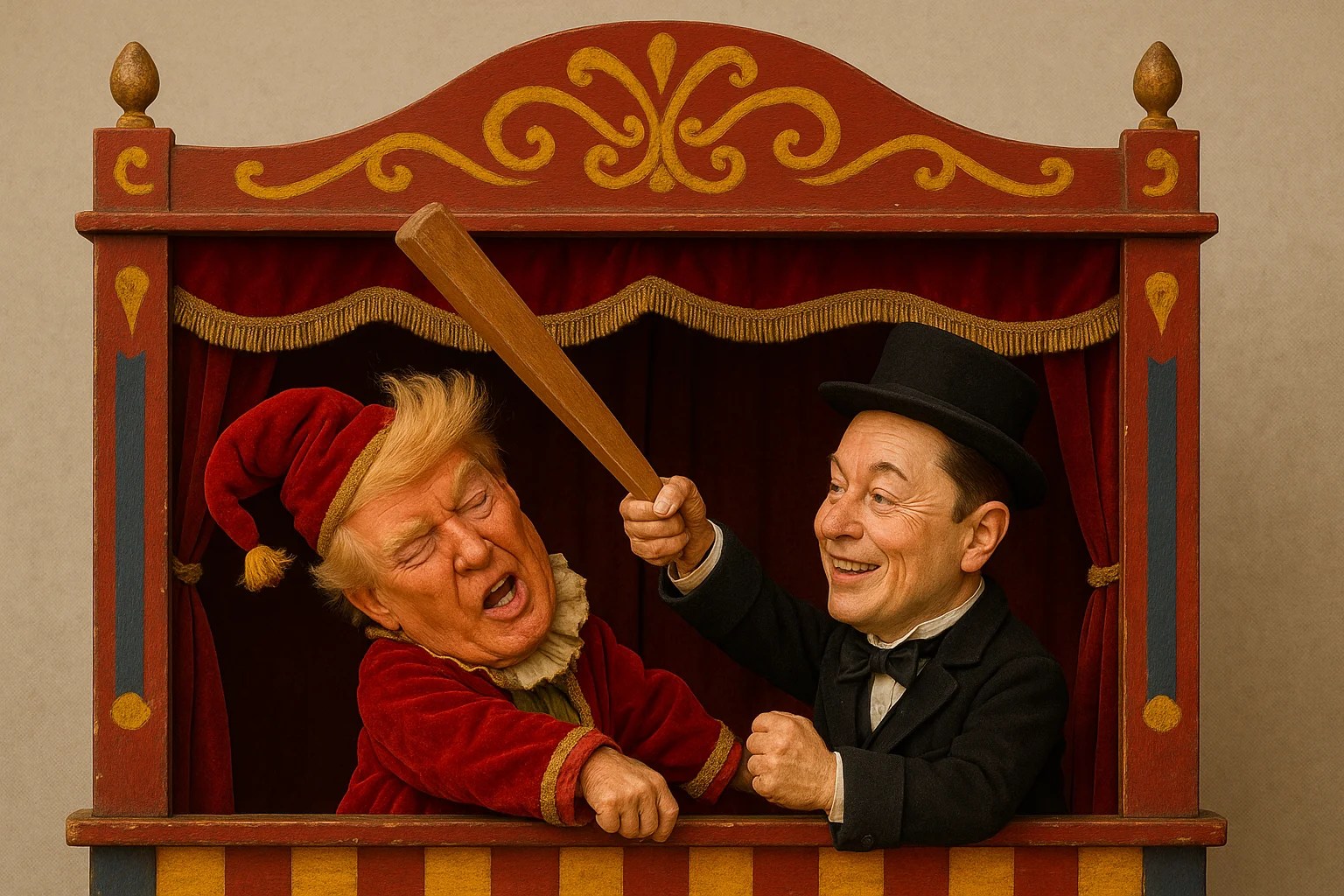
It is Punch and Judy on the world stage, a performance designed to distract, confuse, and entertain. We get so caught up in the political drama that we miss what is happening behind the curtain. The political theorist Noam Chomsky has warned of this for decades, calling it the “illusion of debate”, an enchanting spectacle where we are encouraged to argue, heckle, and voice an outraged opinion, but only about things that don’t truly matter.
Chomsky put it bluntly: “The smart way to keep people passive and obedient is to strictly limit the spectrum of acceptable opinion, but allow lively debate within that spectrum.” We are led into a room and told we can rearrange the furniture as much as we like, but we must never think to knock down the walls. This keeps us feeling engaged while the fundamental systems that shape our lives remain unchallenged.
The high-profile feud between Donald Trump and Elon Musk is a perfect modern case study. The rolling news coverage presents a spectacular public blow-up, with Trump threatening to cut Musk’s multi-billion-dollar government contracts and Musk firing back with personal insults. It feels dramatic and significant.
But while we are glued to our screens, watching the meme wars unfold on social media, we miss the real story: both men are beneficiaries and proponents of the same system. Their public theatre distracts from their shared interest in maintaining corporate power. Trump’s landmark 2017 Tax Cuts and Jobs Act slashed the corporate tax rate from 35% to 21%. Meanwhile, Musk’s companies, such as SpaceX and Tesla, have raked billions from government contracts and subsidies, benefiting from policies that were advanced during the Trump administration and beyond. Despite the public spats, their economic interests align in opposing higher taxes on the wealthy and promoting deregulation.
This is the illusion of debate in action. While the media profits from the drama, critical policy decisions are made in the shadows. Investigations into corporate malpractice are quietly halted, labour laws are weakened, and environmental regulations are rolled back. The spectacle keeps the public divided and misinformed, undermining democratic accountability and preventing any unified challenge to a status quo that overwhelmingly favours elite interests.
This tactic is not new. From the Reagan-era tax cuts sold as “trickle-down economics” to the Clinton-era financial deregulation that paved the way for the 2008 crash, political theatre has long been used to divert public attention while corporate agendas advance.
So, what can we do? The first step is to recognise the performance for what it is. We must learn to ask better questions: not “Whose side are you on?” but “Who benefits from this entire system?“
Secondly, we must actively seek out diverse sources of information, particularly independent journalism that is not beholden to corporate advertisers or political factions. This allows us to see the whole picture, not just the carefully framed sliver presented to us.
Finally, we need to engage with politics more meaningfully. This means focusing on policy, not personality. It means getting involved locally, where our voices have a tangible impact. History shows that it is possible when people come together to demand systemic change. Breaking the spell of the illusion is not just an act of intellectual curiosity but a vital act of democratic self-defence.
Additional Information and Resources:
Table: Summary of Hidden Agendas and Mechanisms:
| Hidden Agenda | Description | Mechanism |
|---|---|---|
| Maintaining Corporate Control | Ensure corporate-friendly policies are implemented without opposition. | Divert attention from lobbying and policy changes. |
| Protecting Elite Interests | Protect wealth and power of elites, including billionaires. | Keep public divided and entertained, preventing unified action. |
| Manipulating Public Perception | Shape opinion in favor of status quo or corporate agendas. | Frame issues as personal conflicts, influencing priorities. |
| Undermining Democratic Accountability | Reduce accountability of officials and corporate leaders. | Distract from transparency demands, focusing on spectacle. |
| Generating Media Profits | Increase viewership and revenue for media companies. | Amplify sensational stories for higher ratings and engagement. |
Key Citations
- Noam Chomsky quote on keeping people passive and obedient
- Understanding Noam Chomsky illusion of free debate
- Necessary Illusions Thought Control in Democratic Societies book
- Notes on political theater perils of spectacle
- Harvard Business Review Corporate Political Spending Is Bad Business
- ScienceDirect The distraction effect political entertainment social media
- WikiUpLib The political theater is a distraction
- University of Rochester Corporate money in politics threatens US democracy
- Project MUSE In the Lurch political theater distraction
- Trump-Musk feud explodes online turns personal with Epstein comments and contract threats
- Trump and Musk’s very public feud is like Alien v Predator for political nerds
- Elon Musk’s Business Empire Scores Benefits Under Trump Shake-Up
- Corruption in plain sight how Elon Musk has benefited from the first 100 days of the Trump administration
Like many writers in 2026, I use AI tools as part of my process, in this case Grok, Perplexity, Grammarly and Gemini, to help with research, brainstorming, exploration, and generating initial drafts and organising complex thoughts. However, this blog is not AI-generated content.
Every post is the result of my own research, lived experience, and extensive rewriting.
The final arguments, metaphors, and conclusions are mine alone. I disclose this because I believe the fight for human creativity begins with honesty about how we create.
 Quentin Budworth