Tag Archives: uk-politics

How The Greens Win The Next General Election

That grinding sense of exhaustion after every election in the UK has to change; we’ve had enough of two-party politics and first-past-the-post and the failed two-party system. Nobody wants to vote as a damage limitation exercise. Holding your nose, ticking a box for the least bad option, and hoping for the best, only to find the ‘best’ felt suspiciously like a slower, slightly more polite version of the same old austere managed decline. That feeling isn’t an accident. It’s the managed despair that keeps a broken two-party system on life support.

But what if that exhaustion is the signal that the game itself is changing? The 2024 election gave Labour a government, but it didn’t provide them with the courage to act on their mandate for real hope. With public support already fraying, a vacuum is opening up on the Left. And it is into this vacuum that the Green Party is stepping, powered not just by a sharp new strategy but by a tidal wave fuelled by hope. With membership surging past 124,000—making them the third-largest party and closing in on the Conservatives—this is no longer just a protest vote. It’s a movement gathering unstoppable force.

This movement is being channelled into a patient, four-phase plan to build a new politics from the ground up.

Phase One: Lay the Foundations in Our Communities. This is where the new energy is most visible. The strategy has already started not in Westminster, but in your town hall, and it’s being executed by a rapidly growing army of activists. The Greens’ 859 councillors are the tip of the spear, but the shaft is the thousands of new members turning up to canvass, deliver leaflets, and stand for election themselves. Every pothole fixed, every local renewable energy scheme approved becomes a proof of concept, building an infrastructure of trust that is powered by sheer people-power.

Phase Two: Inspire a National Conversation. With those local foundations secured by a legion of volunteers, the next step is to take the vision national. This means doubling down on a message of hope that resonates because it’s authentic. The membership surge isn’t happening in a vacuum; it’s a direct response to policies that offer a stark, positive choice: a wealth tax on billionaires to fund public services; bringing energy and rail back into public hands; rent controls to tackle the housing crisis. The strategy is to link these bold ideas to people’s daily lives, framing environmentalism not as a sacrifice, but as the essential toolkit for a fairer, more secure society—a message now amplified by over a hundred thousand voices.

Phase Three: Offer a Clear Choice in the Heartland. This is where the plan becomes truly focused, and where the new-found scale of the party becomes a powerful force for change. The aim is to methodically concentrate on over 100 constituencies where disillusionment with the old parties is highest. An ambition like that would have been a fantasy a few years ago. Now, funded by membership fees and powered by thousands of activists with the enthusiasm the major parties can only dream of, it becomes a credible alternative. This is how you create a green breakthrough: by having the boots on the ground to give voters a genuine choice, converting apathy into engagement and winning a formidable bloc of Green MPs.

Which brings us to Phase Four: Reshape the System for Good. This is the ultimate goal. The most realistic path to power isn’t winning 326 seats outright, but winning enough—perhaps 40, perhaps 60—to hold the balance of power. A strong bloc of Green MPs, backed by the largest and most engaged activist base in the country, would enter a hung parliament not merely as junior partners, but as architects of a new democracy with a non-negotiable mandate: electoral reform. With nearly 70% of the public supporting Proportional Representation, this is the moment you translate people-power into permanent, systemic change.

So, what does this mean for you, nursing that feeling of political burnout? It means recognising that the cage has no bars, and that you are not alone. The first step is internal: stop seeing politics as something done to you. But the most vital step is external. The energy fuelling this entire strategy isn’t coming from focus groups; it’s coming from people like you. When you join this movement, you aren’t just adding your name to a list. You are the fuel. You are the hands that help lay the foundations in Phase One, the voice that inspires the conversation in Phase Two, and the engine for the breakthrough that will make the old politics obsolete.

Why the ‘Common Sense’ Bloke Down the Pub is Britain’s Most Dangerous Con

We need to talk about Nigel. It’s the cognitive dissonance that gets you first. The charming common sense everyman voice, the pint in hand, the easy confidence of someone who sounds both posh and plausible. And then come the words. Bitter, divisive words, spouting the worst kind of rhetoric, but delivered as if he’s just commenting on the weather. As if it’s perfectly normal, perfectly acceptable, to speak of your neighbours and fellow citizens with such casual contempt. The truth is, it isn’t. And that gap—between the slick presentation and the toxic substance, is the most dangerous political space in Britain today.

This performance is not an accident. It’s a finely-tuned political instrument designed to do one thing: to make the unthinkable seem reasonable. The charm is the anaesthetic before the surgery. It lowers your defences, making you receptive to the simple, satisfying diagnosis for that low, persistent hum of anxiety we all feel. It takes your legitimate anger about a broken system and, with a friendly wink, points it towards a simple enemy. It’s a strategy, and it works by making prejudice sound like common sense.

Once you’ve accepted the premise, the policies write themselves. Look at the plans for immigration. They are the logical conclusion of this normalised division. Abolishing the right of people who have lived and worked here for years to call this country home? It stops sounding cruel and starts sounding like ‘management’ when you’ve been told they are a burden. Tearing up international human rights laws? It’s no longer a shocking breach of our values, but a ‘necessary step’ to deal with an invasion. Each policy is another brick in a wall built to divide us, turning the complex failings of the state into a simple story of ‘us versus them’.

Then comes the second front of the attack, aimed not at our borders but at the very heart of our communities. The war on “woke.” The crusade to scrap diversity and equality initiatives. This is the mission to purify the ‘us’ group. It’s a direct assault on the messy, complex, brilliant reality of modern Britain. It sends a clear message that fairness has gone “too far,” that protecting minorities is an attack on the majority. It is a project designed to dismantle empathy, to label tolerance as a weakness, and to give bigotry a political permission slip.

And here is the raw truth we must confront: none of this is about fixing the problems that keep you up at night. Your council tax, the state of the NHS, the price of the weekly shop—these are just the emotional kindling for their fire. The goal isn’t to solve anything. The goal is to keep you angry. It is a political model that thrives on our exhaustion and profits from our division. It is a poison that paralyses our ability to look at our real problems and work together to solve them.

So, what on earth do we do? The first act of resistance is to break the spell. It is to see the performance for what it is: a con. It means actively refusing to swallow the daily diet of rage being served up. Practise ‘informational hygiene’. Guard your own resilience as if it were armour, because that’s exactly what it is. To stay calm and clear-headed in a storm of manufactured hysteria is a radical act.

But personal resilience is just the start. The real antidote to this division is connection. This is the unglamorous, vital, and urgent work ahead. It means rebuilding the bonds they are trying to sever, one conversation at a time. Talk to your actual neighbours. Have the quiet courage to challenge the divisive rhetoric when you hear it from a friend, not with aggression, but with a firm refusal to let it stand. And yes, get involved. Join the most boring-sounding local committee you can find. Be part of the levy that shores up the flood defences of our shared civic decency.

Because that is precisely what is at stake. They are selling a story of a broken Britain that can only be saved by breaking it apart even further. Our job is to tell a better story—and not just to tell it, but to live it. A story built not on fear and suspicion, but on the quiet, stubborn, and profoundly British belief that we are, and always will be, better than this.

In more detail with links

London, UK – A range of policies proposed by Reform UK, particularly concerning immigration, multiculturalism, and equality, have faced widespread criticism for being racist, divisive, and detrimental to social cohesion, according to analyses from political opponents, media reports, and think tanks. While Reform UK asserts its platform addresses legitimate public concerns, critics argue that many of their proposals target minority groups, fuel anti-immigrant sentiment, and could erode community harmony.

Immigration Policies at the Forefront of Controversy

Reform UK’s stringent immigration policies have drawn the most significant condemnation. Proposals to freeze non-essential immigration, leave the European Convention on Human Rights (ECHR), and implement offshore processing for asylum seekers have been labeled as “racist” and “immoral” by opponents.[1] Critics, including Labour leader Keir Starmer, argue that such measures scapegoat immigrants for broader societal problems and normalize state-sanctioned racism.[1][2]

One of the most contentious proposals is the plan to abolish Indefinite Leave to Remain (ILR), a move that could affect hundreds of thousands of legal residents. Starmer has vehemently opposed this, stating it would “rip this country apart” by targeting neighbors and contributors to the economy.[1][3] In response, Reform UK’s head of policy, Zia Yusuf, accused Labour of telling the electorate to “pay hundreds of billions for foreign nationals to live off the state forever, or we’ll call you racist!”[1]

Further proposals, such as a 20% National Insurance surcharge on employers hiring foreign workers and restrictions on international students bringing dependents, have also been criticized as discriminatory and echoing past anti-immigration rhetoric.

Challenges to Multiculturalism and Equality

Reform UK’s stance on multiculturalism and its pledge to scrap Diversity, Equality, and Inclusion (DEI) initiatives have intensified accusations of divisiveness. The party’s manifesto states it would replace the Equality Act, which it claims “requires discrimination in the name of ‘positive action'”.[4] Party leader Nigel Farage has been a vocal critic of DEI, and following success in local elections, has vowed to dismantle what he terms the “DEI industry” in councils under Reform control.[5][6]

Legal experts have warned that abolishing DEI roles could breach the Public Sector Equality Duty, a legal requirement for public bodies to eliminate discrimination and promote equality.[5] Critics argue these policies threaten years of progress on workplace equality and could embolden prejudice.[6] The Good Law Project has accused Reform UK of using women’s safety as a “cover for racism” by linking migration to sexual assault without credible evidence.[7][8]

Divisive Rhetoric and the Impact on Social Cohesion

Commentators suggest that Reform UK’s policies and rhetoric are tapping into a sense of public disillusionment and despair, refracting class anger through a racist lens.[9] The party’s success is seen by some as being built on exploiting fears about immigration and a loss of national identity.[9][10] The rhetoric used by some associated with the party has also come under fire. An undercover investigation revealed a Reform UK canvasser using a racial slur against Prime Minister Rishi Sunak and suggesting migrants crossing the Channel should be shot.[11]

While Keir Starmer has labeled some of Reform’s policies as racist, he has been careful to state that he does not believe all Reform voters are racist, acknowledging their frustration with the political status quo.[2][12][13] However, critics maintain that the party’s platform risks normalizing extremist views and undermining the social fabric of the UK.[9][10] A poll by British Future found that four in ten people believe Reform is a racist party, a perception more pronounced than that of UKIP in 2015.[14]

Reform UK defends its policies as necessary for border security and preserving British culture and values.[15] The party’s rise in popularity, particularly its strong performance in the 2024 general election and its significant presence on social media, indicates that its message resonates with a substantial portion of the electorate.[16][17] Nevertheless, the divisive nature of its platform continues to be a central point of contention in British politics.

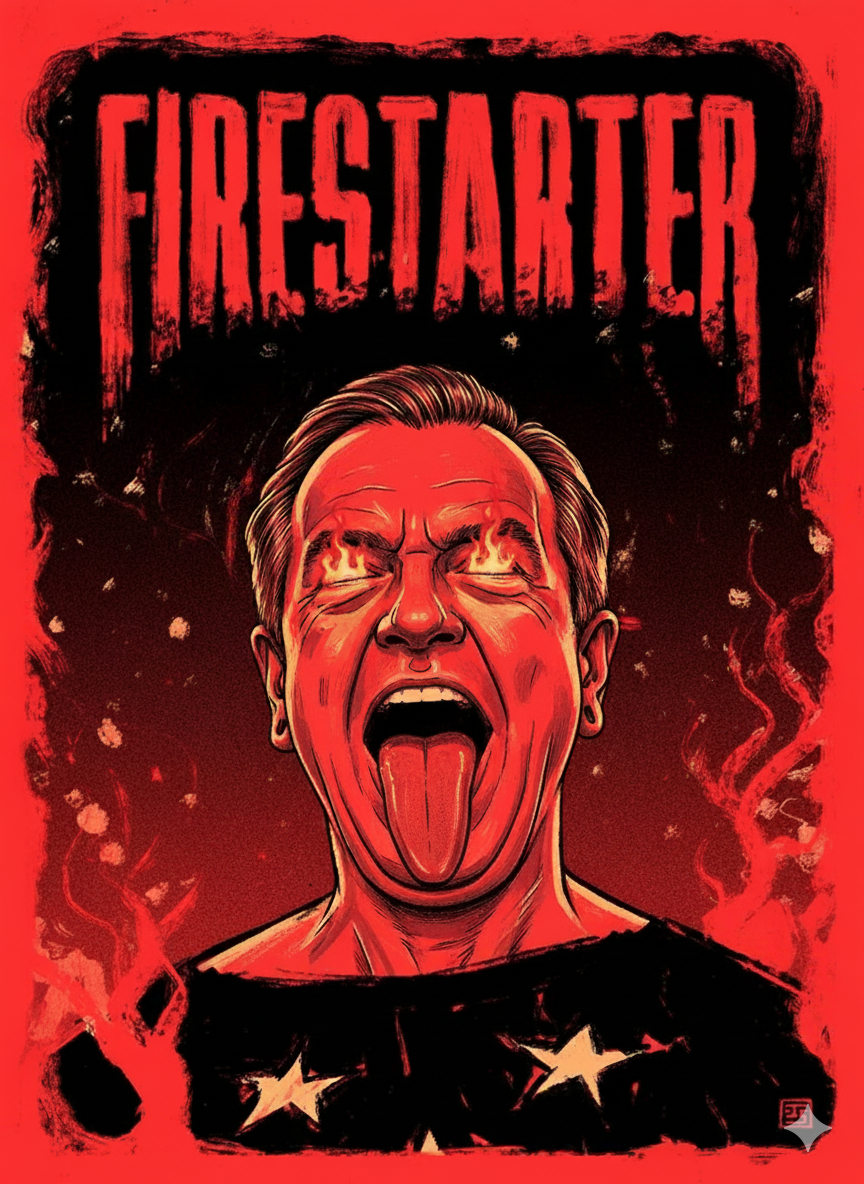
The Arsonist, The Pint And The Keys to Number 10

Nigel Farage has thrived as a political insurgent and would be useless as an incumbent of political office, like the turd that won’t flush. He has become a constant fixture in the feckless punditry of the media class, proffered to the disenfranchised and angry as a universal panacea for their grinding poverty and relentless exploitation. His is the politics of hate and eugenics dressed up in red, white, and blue.

But there really is hope.

For alongside the stench of stale ale, fags, and old roubles, there is the toxic whiff of yesterday’s news about him. Like your hate-filled racist uncle, he has overstayed his welcome, another Trump tribute act and just one repeat appearance too many from Aunty Beeb.

Nigel Farage embodies feelings of visceral disgust and a sense of national embarrassment. Drunk on attention, he refuses to leave the political stage, even as we grapple with a terrifying political reality. The weariness is palpable; the sense that those in charge are not just failing but speaking a different language has curdled into a desperation for anyone to dismantle the rotten structure. Recent polling even suggests this desperation could make him Prime Minister. The bloke from the pub, the uncle you avoid at family gatherings, could soon be the resident of Number 10. The fundamental problem with professional arsonists, of course, is that you should never, ever ask them to look after the matches or give them the keys to your house.

You have to hand it to him, the man knows his craft. For three decades, Farage has perfected the art of the political insurgent. He is a master diagnostician of national discontent, tapping into the veins of frustration over immigration, sovereignty, and a sneering elite with unerring accuracy. His victory with the Brexit campaign wasn’t a fluke; it was the culmination of a career spent turning apathy into anger, and anger into votes. He is a brilliant campaigner, a savvy media operator who can turn a cancelled bank account into a national crusade and command a stage with the practiced ease of a seasoned broadcaster. He provides a simple, satisfying release valve for a complex and paralysing pressure. He gives you someone to blame. And in a world that feels chaotic and nonsensical, that is a powerful, seductive gift.

But here’s the rub: the skills required to tear a house down are the polar opposite of those needed to build one. The insurgent’s armoury – the pint, the fag, the sharp soundbite – becomes a liability in the quiet corridors of power where detail, diplomacy, and diligence are the currency. This is a man who has serially quit every major leadership role he’s ever had, often vanishing in a puff of drama only to return when the spotlight beckoned once more. He has never run a government department, never managed a large-scale bureaucracy, and surrounded himself with a party whose own candidates have a history of scandal and incompetence. His entire career has been a protest against the establishment; he has no experience, and seemingly no interest, in the grinding, unglamorous work of actually being it.

Worse, his playbook for power is a recipe for national disaster. He championed Liz Truss’s catastrophic mini-budget, a policy that sent the markets into a tailspin, and seems keen to repeat the experiment. Analysts warn a Farage premiership could trigger a 20% collapse in the pound, with inflation and mortgage rates soaring into double digits. His signature policy, Brexit, is a project he now openly admits has failed, yet his solution is inevitably more of the same poison. That stench of stale ale and old roubles you mentioned isn’t just an aesthetic; it’s the smell of economic instability and diplomatic isolation. It’s the toxic whiff of a man still shouting the same old slogans as the world moves on, leaving us to live with the consequences.

So, what do we do? It’s easy to feel helpless, to simply ride the wave of outrage and despair. But that is exactly what this brand of politics wants. It thrives on our exhaustion. The real act of rebellion, the truly patriotic act, isn’t to find a louder strongman to shout back. It is to deny the outrage-merchants their fuel. It starts with a quiet, personal insurgency: curating your media diet with ruthless discipline, practising what you might call informational hygiene, and refusing to let your emotional state be dictated by the latest manufactured controversy.

And then you take that resilience outside. The antidote to the grand, empty spectacle of national politics is the tangible reality of local action. Find the most boring-sounding local committee you can – planning, parks, the parish council – and join it. Re-engage with the civic fabric of your community by talking to people. Build something. Fix something. This is the painstaking, vital work of democracy. It’s the levy that shores up the flood defences against the tide of populism. It is how we prove that real power doesn’t come from a bloke shouting in a television studio, but from the collective, determined effort of people who have decided, quietly and firmly, to take back control for themselves.