Tag Archives: #ZackPolanski

How The Greens Win The Next General Election

That grinding sense of exhaustion after every election in the UK has to change; we’ve had enough of two-party politics and first-past-the-post and the failed two-party system. Nobody wants to vote as a damage limitation exercise. Holding your nose, ticking a box for the least bad option, and hoping for the best, only to find the ‘best’ felt suspiciously like a slower, slightly more polite version of the same old austere managed decline. That feeling isn’t an accident. It’s the managed despair that keeps a broken two-party system on life support.

But what if that exhaustion is the signal that the game itself is changing? The 2024 election gave Labour a government, but it didn’t provide them with the courage to act on their mandate for real hope. With public support already fraying, a vacuum is opening up on the Left. And it is into this vacuum that the Green Party is stepping, powered not just by a sharp new strategy but by a tidal wave fuelled by hope. With membership surging past 124,000—making them the third-largest party and closing in on the Conservatives—this is no longer just a protest vote. It’s a movement gathering unstoppable force.

This movement is being channelled into a patient, four-phase plan to build a new politics from the ground up.

Phase One: Lay the Foundations in Our Communities. This is where the new energy is most visible. The strategy has already started not in Westminster, but in your town hall, and it’s being executed by a rapidly growing army of activists. The Greens’ 859 councillors are the tip of the spear, but the shaft is the thousands of new members turning up to canvass, deliver leaflets, and stand for election themselves. Every pothole fixed, every local renewable energy scheme approved becomes a proof of concept, building an infrastructure of trust that is powered by sheer people-power.

Phase Two: Inspire a National Conversation. With those local foundations secured by a legion of volunteers, the next step is to take the vision national. This means doubling down on a message of hope that resonates because it’s authentic. The membership surge isn’t happening in a vacuum; it’s a direct response to policies that offer a stark, positive choice: a wealth tax on billionaires to fund public services; bringing energy and rail back into public hands; rent controls to tackle the housing crisis. The strategy is to link these bold ideas to people’s daily lives, framing environmentalism not as a sacrifice, but as the essential toolkit for a fairer, more secure society—a message now amplified by over a hundred thousand voices.

Phase Three: Offer a Clear Choice in the Heartland. This is where the plan becomes truly focused, and where the new-found scale of the party becomes a powerful force for change. The aim is to methodically concentrate on over 100 constituencies where disillusionment with the old parties is highest. An ambition like that would have been a fantasy a few years ago. Now, funded by membership fees and powered by thousands of activists with the enthusiasm the major parties can only dream of, it becomes a credible alternative. This is how you create a green breakthrough: by having the boots on the ground to give voters a genuine choice, converting apathy into engagement and winning a formidable bloc of Green MPs.

Which brings us to Phase Four: Reshape the System for Good. This is the ultimate goal. The most realistic path to power isn’t winning 326 seats outright, but winning enough—perhaps 40, perhaps 60—to hold the balance of power. A strong bloc of Green MPs, backed by the largest and most engaged activist base in the country, would enter a hung parliament not merely as junior partners, but as architects of a new democracy with a non-negotiable mandate: electoral reform. With nearly 70% of the public supporting Proportional Representation, this is the moment you translate people-power into permanent, systemic change.

So, what does this mean for you, nursing that feeling of political burnout? It means recognising that the cage has no bars, and that you are not alone. The first step is internal: stop seeing politics as something done to you. But the most vital step is external. The energy fuelling this entire strategy isn’t coming from focus groups; it’s coming from people like you. When you join this movement, you aren’t just adding your name to a list. You are the fuel. You are the hands that help lay the foundations in Phase One, the voice that inspires the conversation in Phase Two, and the engine for the breakthrough that will make the old politics obsolete.

The Politics of Hope & The Economics of Care: A Radical New Vision For Britain

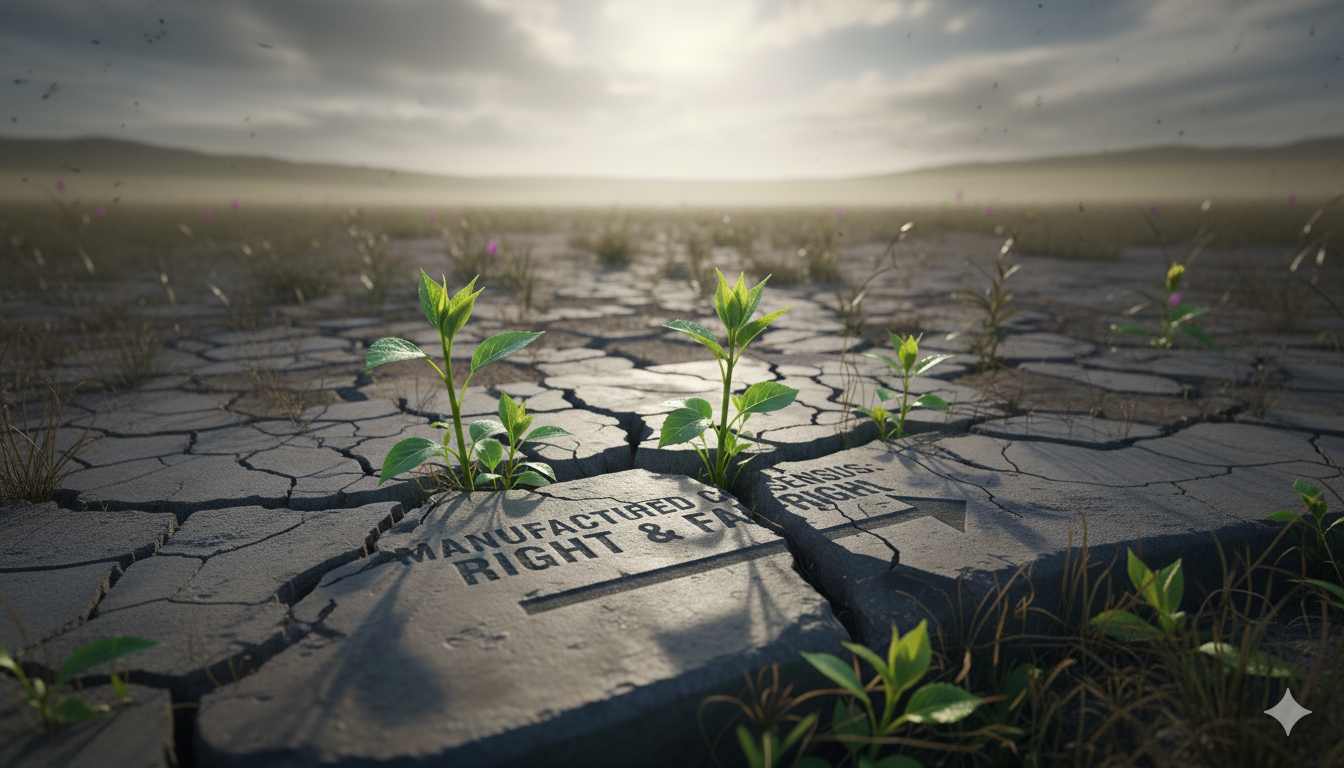
It is time for change, and it’s happening now. Real green shoots, new progressive ideas, are breaking through the manufactured concrete consensus that the only direction is right and then far-right.

People are resonating with that deep ache for something fundamentally different, a yearning for a world not defined by the relentless pursuit of profit or the cynical machinations of power, but by genuine human connection and collective well-being. We’ve had enough of the politics of despair, the economics of extraction. What we desperately need now is a politics of hope and an economics of care.

This isn’t just a nice idea; it’s an urgent necessity in a UK landscape dominated by a uni-party consensus that offers little more than managed decline, all while the far-right seeks to deepen the chasms between us. The ‘Friendly fascism’ and centrist authoritarianism we see here thrives on a profound lack of hope, on the exhaustion wrought by a system that consistently prioritises abstract market forces over the tangible needs of people. The hypernormalisation of austerity, the dehumanising rhetoric aimed at anyone struggling to survive, the relentless information overload – it’s all designed to drain our will to fight for something better.

So, what do we actually do? We plant the seeds of that hope, and we cultivate that care, refusing to let the cynicism of others define our future. For me, and for a growing chorus of voices, that means actively building a political movement that embodies these very principles – and that’s precisely what we’re doing with the Green Party. While others offer more of the same, praying at the altar of Neo-liberalism and allowing big money and foreign influence to dictate their every move, we are forging an alternative rooted in genuine compassion and a vision for a just future.

A politics of hope means daring to imagine a country where everyone has a safe, warm home, where our NHS is not just protected but properly funded, where our communities are vibrant and resilient, and where our planet is not sacrificed for short-term gain. It means challenging the insidious lie that there is no alternative to the current trajectory. And an economics of care means fundamentally reorienting our priorities: away from endless growth and towards meeting the needs of all, ensuring dignity for workers, protecting our precious natural resources, and fostering genuine well-being over corporate spreadsheets. It means valuing the essential work of caring for each other, for our children, for our elders, and for our environment, not just the financial transactions that boost GDP.

The culture war, stoked by the far-right and amplified by a complicit media, is a deliberate distraction from this fundamental shift. It’s designed to keep us from uniting around shared values of hope and care. We must see through it and expose it for what it is: a cynical ploy to protect the interests of the powerful by fragmenting the rest of us. When they scream about ‘woke’ ideology, we talk about universal basic income, robust public services, and truly affordable housing – the bedrock of an economics of care.

Fascists thrive on scarcity and fear. A politics of hope and an economics of care counters this directly by affirming abundance and mutual aid. We refuse to let them redefine who is ‘deserving’ of care; we insist that every life has intrinsic value. And when it comes to the Labour and Conservative uni-party, beholden as they are to big money, we expose their rhetoric for what it is: a thinly veiled defence of the status quo, offering managed decline instead of genuine transformation. Austerity instead of abundance.

My own journey has shown me that breaking through these entrenched narratives requires persistent, empathetic communication. We need to reach those who feel disillusioned, those who have been let down by decades of Neo-liberal consensus, and show them that hope isn’t naive – it’s a powerful engine for change. The Green Party’s rapid growth isn’t just about environmentalism; it’s about a fundamental commitment to a politics of hope and an economics of care, a vision that resonates deeply with people who are tired of being told there’s no alternative.

Paulo Freire’s call for critical consciousness is absolutely paramount here. We must question the very foundations of an economic system that prioritises profit over people, and a political system that claims to be democratic while being controlled by external forces. We must empower ourselves, and our communities, to imagine and build an entirely new way of organising society – one based on collaboration, compassion, and true sustainability.

Yes, the fight is monumental. The forces of cynicism and greed are deeply entrenched. But we cannot surrender. We must protect our humanity, our empathy, and our capacity for hope, because these are our most potent weapons. Join your local Green Party. Get involved. Speak truth to power. Demand a politics of hope and an economics of care, not just as abstract ideals, but as the foundational principles of a society truly fit for the 21st century. The most anti-fascist act any of us can make, in the face of managed decline and manufactured misery, is to stubbornly, defiantly, hold onto that vision and work every single day to bring it into vibrant, caring reality.

The Royal Rumble for Britain’s Soul.

Picture the scene: a political Royal Rumble. For years, the ring has been dominated by two tired, lumbering heavyweights, Labour and the Conservatives, whose moves are predictable and whose passion is long gone. The crowd is bored. Restless. Angry. Sensing weakness, a new tag team has stormed the ring: Nigel Farage on the microphone, the master promoter, and Tommy Robinson as his street-fighting enforcer. They’ve got a simple, brutal story the crowd can chant along to. The old champions look lost. Then, just as the match seems to be slipping away, two new contenders jump the ropes, ready to fight. And they have a game plan.

First in the ring is Gary Stevenson, the brawler from East London. He’s not here for the fancy stuff. His finishing move is The Truth, and he delivers it with the force of a powerhouse. He steps up to the mic and hammers home one relentless, uncomfortable fact: this country is being bled dry. A billion pounds, untaxed, generates a million pounds a week in passive income. It’s a runaway train, and your life is on the tracks. He doesn’t need a script; his authenticity is his weapon. The crowd believes him because he is them. But a brawler, no matter how powerful, needs a strategist in his corner.

That’s where Zack Polanski comes in. He’s the high-flyer, the tactician. He sees the whole ring, understands how the ropes of the climate crisis are connected to the turnbuckles of social inequality. He’s not just here for one match; he’s building a political stable—a revitalised Green Party—to fight for the championship belt. He sees the anger in the crowd and knows it’s the energy source that can power a real movement, transforming boos and cheers into a political force that can’t be ignored. But what’s their strategy against the current, failing champions?

Let’s be blunt: the reigning champions, Labour, are finished. They look the part, but they’re slow, complacent, and fighting the last war. They’re “in hock” to their corporate sponsors, their billionaire donors. They’re deaf to the roar of the crowd. Stevenson tells how he tried to hand them the playbook for victory, a plan for a wealth tax the public is crying out for, but they weren’t interested. They’re about to make a rookie mistake—a disastrous November budget that will leave them wide open. And that’s when the real villains of this story will make their move.

Because the most dangerous force in the ring isn’t the tired champion; it’s the perfectly executed heel tag team of Farage and Robinson. This is Stevenson’s crucial insight. Their success comes from a “WWF-style multiplicity of voices.” Farage, the slick promoter, works the media, cutting promos that blame every problem on the outsider. Robinson, the enforcer, takes that same message to the streets, creating chaos and viral clips. Together, they create a constant wall of noise that feels bigger than it is, making their fringe ideas feel like the mainstream. They have filled the void left by the champions.

So here’s the game plan. You don’t beat a tag team like that one-on-one. You build a better stable. A bigger one. The strategy is to turn the entire crowd into a new faction, a multiplicity of voices for fairness and hope. It needs ordinary people telling their own stories, becoming the third, fourth, and fifth person in the ring. It needs political leverage, with the Greens winning seats and making a wealth tax the non-negotiable price of power. The choice is now a straight one: a championship victory for a Britain of shared prosperity, or a permanent win for the promoters of hate and a future of slums for the 90%. The bell is about to ring.