By Quentin Budworth
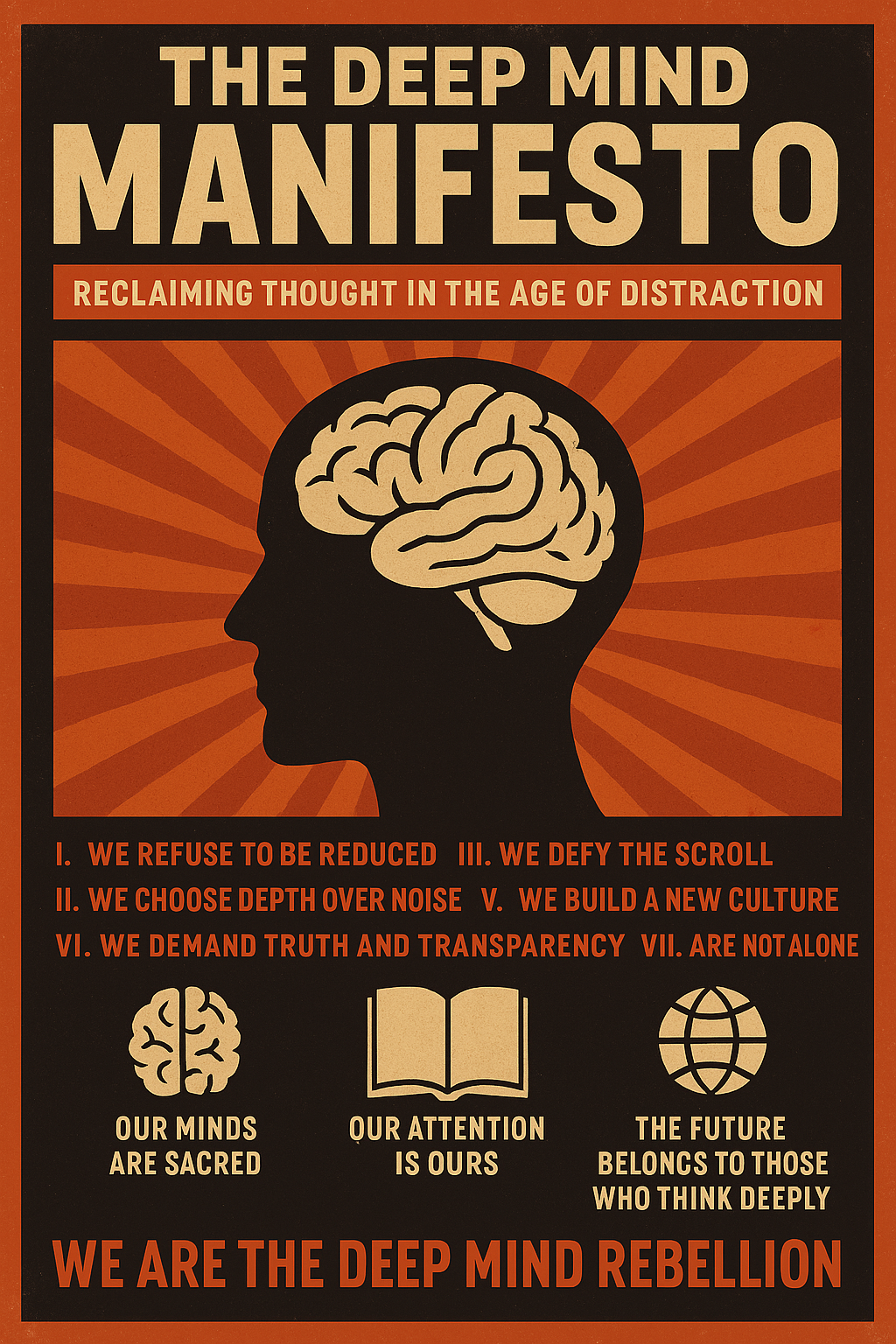
I’m going to start this essay with a call to arms:
wAkE uP!
Reclaim your mind.
Rebuild your depth.
Resist the scroll.
Read. Reflect. Rebel.
The future depends not on what we know, but on how deeply we’re willing to think.
We are living through a crisis of thought, not a lack of it, but its steady degradation. What once demanded our full attention—reading a book, following a line of reasoning, sitting with discomfort—has been replaced by the infinite scroll, the notification ping, the algorithmically curated outrage. We are not becoming stupid. We are becoming shallow.
In The Shallows, Nicholas Carr warned that the internet wasn’t just a tool—it was a medium that reshapes its users. By fragmenting attention and encouraging distraction, it trains us to skim rather than contemplate, react rather than reflect. Over a decade later, the stakes are higher than ever. We are not just distracted—we are being reprogrammed.
From Platform to Prison
Today’s platforms are machines built for one thing: extraction. Not of oil, or coal, but of attention. Meta, TikTok, Google—they are not in the business of connection, but of commodification. They refine your thoughts into data, your time into revenue. Their algorithms learn not what you need to see, but what will keep you watching. What will keep you angry. What will keep you numb.
This isn’t an accident. It’s design. Every flicker of stimulation rewires your brain. Every shallow interaction erodes your capacity for depth. A mind trained to swipe cannot sustain belief. A culture trained to skim cannot sustain democracy.
Power Thrives on Shallow Minds
Let’s not pretend this is just about tech. This suits power—political, economic, oligarchic—just fine. The more distracted we are, the less dangerous we become.
In China, surveillance is direct. The state tracks your movements, monitors your score, controls access to basic services. In the West, it’s softer, subtler, and arguably more effective. Your desires are mapped, monetised, and manipulated. Your worldview is shaped by search results tailored to keep you clicking. The line between influence and control has vanished.
And in this new order, truth becomes negotiable. Not because it no longer matters, but because it can’t be found through the noise.
The Assault on Education and the Self
In schools, children raised on hyper-stimulation struggle to read a page without fidgeting. Attention spans collapse under the weight of infinite choice. Teachers are told to entertain, not educate. Depth is boring. Nuance is elitist. Thinking is too slow.
Meanwhile, creativity is throttled by algorithmic gatekeepers. Artists chase metrics. Writers are nudged towards virality. Expression flattens into content. The personal becomes performative.
Even memory is outsourced. Google knows more than you do, so why bother remembering? Your phone holds your appointments, your thoughts, your navigation. The self becomes a user profile: optimised, marketable, but increasingly hollow.
This Is a Crisis. But It’s Not Inevitable.
There is no law that says technology must dull us. There is no algorithm so powerful it cannot be resisted. But we must choose to fight.
We start by rebuilding the muscles of depth. We read. Slowly. We write, not to perform but to understand. We speak in full sentences. We listen without reaching for our phones. We create spaces where thought can breathe—offline, unrecorded, undistracted.
We demand public digital infrastructure that serves truth, not engagement. Platforms that elevate knowledge, not noise. We teach children how to think, not just how to pass. We break the grip of monopolies who treat cognition as a commodity.
And we recognise that attention is not just personal—it is political. The struggle for a free mind is the struggle for a free society.
This is a call to arms.
Reclaim your mind. Reclaim your time. Reclaim your attention.
Because what they cannot sell, they cannot control. And what you choose to protect—your thoughts, your focus, your depth—is the first act of resistance.
Not everything worth knowing comes in a feed. Not everything worth doing comes easily.
But some things are worth the fight.
And the battle for the mind is one we cannot afford to lose.
 Quentin Budworth